

Beyond Smart—The Dawn of the AI-First City

Imagine an urban water main bursting in 2025. In a merely connected city, sensors might alert a central command, which then dispatches a crew to a traffic-snarled street. In an AI-First city, the narrative is fundamentally different. Weeks before, an AI model, analyzing infinitesimal changes in pipe pressure, acoustic data, and soil conditions, predicted a 95% probability of failure. It automatically scheduled preventative maintenance for an off-peak night, pre-ordered the necessary parts, and simulated traffic rerouting to ensure minimal disruption. This is not a story about technology; it is a story about foresight. It is the tangible result of a paradigm shift from building "smart cities" to architecting "intelligent urban ecosystems."
This evolution is powered by AI-First thinking, a strategic reorientation that places artificial intelligence at the very core of every process, workflow, and decision. It is not about augmenting existing municipal operations with AI tools; it is a fundamental redesign of how a city functions, starting from the premise that AI can reason, predict, and learn. This mindset moves beyond isolated pilot projects to embed intelligence into the everyday fabric of urban life, reimagining solutions to problems that were previously considered intractable. The approach prioritizes using AI to accomplish any task, falling back on traditional methods only when AI falls short. Crucially, this is not an "AI-only" vision that discards human expertise. Instead, it leverages AI to further human goals, with human oversight essential for guiding strategy, managing bias, and ensuring responsible deployment.
The initial concept of the "smart city" was largely technology-led, focused on deploying vast networks of sensors and Information and Communication Technology (ICT) infrastructure to collect data about traffic, energy, and public services. While a necessary first step, this approach often resulted in data-rich but insight-poor environments. The AI-First city represents the next evolutionary stage. It uses this torrent of data as fuel for a constantly learning "city brain"—a network of algorithms that can adapt, predict, and optimize outcomes automatically. The strategic focus has inverted. The old model asked, "How can we use technology to fix this existing problem?" The AI-First model asks, "Given that AI can predict and automate, what new problems can we solve, and which of our core processes must we fundamentally redesign?" This shift is profound, moving the goalposts from mere efficiency to genuine intelligence, resilience, and enhanced livability.
This article analyzes the five pivotal innovations that define the AI-First city in 2025, supported by real-world deployments from global urban leaders. It will examine the convergence of AI and IoT, the strategic power of digital twins, the optimization of urban resources, the dawn of adaptive mobility, and the personalization of citizen services. The analysis culminates in a strategic playbook for executive leaders tasked with navigating this transformation and future-proofing their urban centers.
I. The Urban Nervous System: AIoT and Digital Twins as Core Infrastructure

The foundation of an AI-First city is not built on concrete and steel, but on data and intelligence. The convergence of the Artificial Intelligence of Things (AIoT) and city-scale digital twins creates a dynamic, sentient infrastructure—a central nervous system that allows the city to sense, understand, simulate, and act with unprecedented precision.
The Sentient City: The Convergence of AI and the Internet of Things (AIoT)
The Sentient City is based on the fusion of AI's analytical and decision-making capabilities with the vast data-gathering reach of the Internet of Things (IoT). This combination creates a city-wide nervous system where billions of connected devices—from traffic cameras and environmental sensors to smart utility meters and public assets—do more than just report data; they provide the inputs for intelligent, automated action. This ecosystem moves beyond simple monitoring to enable predictive maintenance on bridges, adaptive traffic management at intersections, and hyper-efficient public service delivery, fostering more resilient and responsive governance structures.
This real-time responsiveness is made possible by two critical enabling technologies: 5G-Advanced and edge computing. The rollout of 5G-Advanced networks provides the high-bandwidth, ultra-reliable low-latency communications (URLLC) necessary to transmit massive data volumes from countless sensors. Simultaneously, edge computing processes this data locally, at or near the source, rather than sending it to a centralized cloud. This decentralization is essential for applications where split-second decisions are critical, such as collision avoidance for autonomous vehicles or immediate alerts for public safety threats.
The City in Silicon: Digital Twins as the Strategic Sandbox
A city-scale digital twin is far more than an interactive 3D map. It is a dynamic, virtual replica of a city's physical assets, systems, and processes, continuously updated with real-time data fed from its AIoT sensor network. Its primary function is to serve as a high-fidelity, risk-free strategic sandbox where urban planners, policymakers, and engineers can simulate and analyze complex scenarios before committing resources in the physical world.
With a digital twin, a city can model the cascading effects of a new metro line on traffic patterns, property values, and air quality. It can test various climate adaptation strategies, such as simulating the cooling effect of new green spaces to mitigate urban heat islands. Emergency response plans can be war-gamed against simulated floods or earthquakes to identify bottlenecks and optimize evacuation routes. With ABI Research predicting that over 500 cities will have adopted digital twins by the end of 2025, this technology is rapidly becoming a standard and indispensable tool for modern urban planning.
This combination of AI-First thinking and digital twin technology also creates a powerful new platform for more democratic and ethical governance. A key barrier to smart city adoption has been a lack of citizen engagement and trust, with many initiatives perceived as technocratic, top-down projects imposed on the public. A digital twin makes abstract policy decisions tangible and visual. For example, instead of just reading a report, citizens can see a virtual representation of a proposed high-rise development and its impact on neighborhood sunlight and traffic. When coupled with an AI that can model second-order impacts, the platform becomes even more powerful. The AI can run simulations to flag potential equity issues, reporting that a new transit plan, while reducing overall commute times, might disproportionately benefit affluent areas while increasing noise pollution in low-income communities. This transforms the digital twin from a purely technical planning tool into a platform for transparent, data-driven public debate, allowing for the co-creation of more equitable and just urban policies.
Global Leaders Spotlight
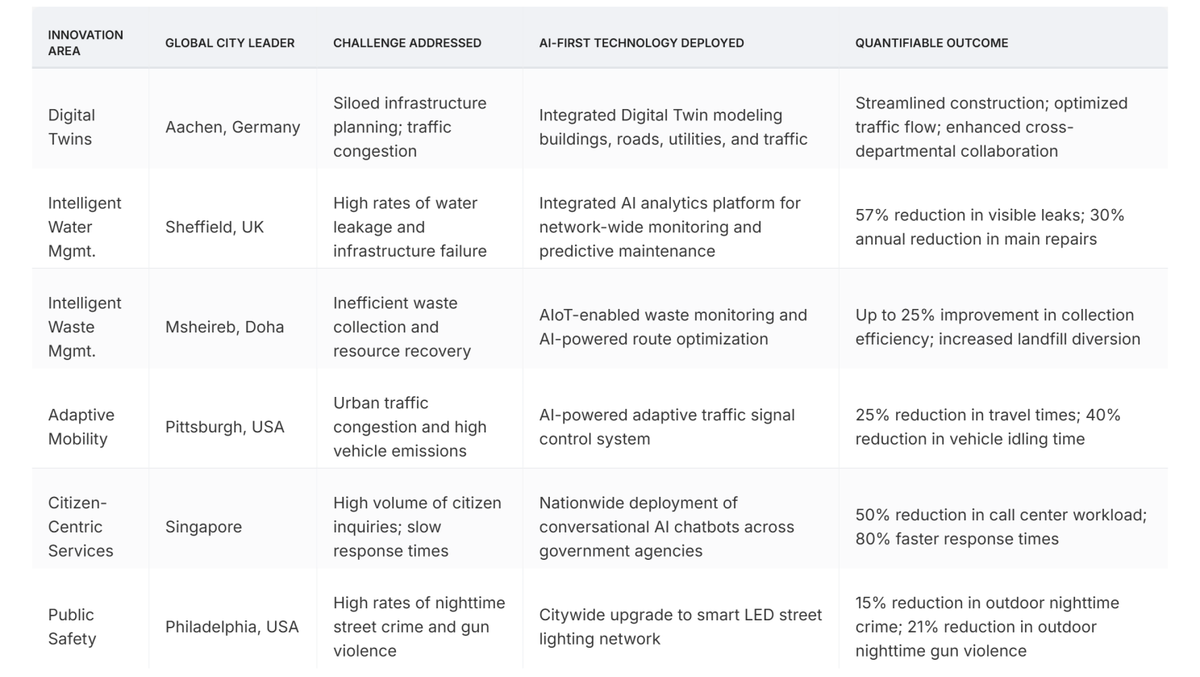
- Aachen, Germany: This city exemplifies the power of an integrated digital twin. Its model incorporates data from "on, above, and below the road," including buildings, infrastructure, underground utilities, and even sewerage assets. The outcome has been a transformation in urban management, leading to streamlined construction planning, improved traffic flow through predictive analysis, and unprecedented cross-departmental collaboration within the municipal administration.
- Enschede, Netherlands: A prime case study in using a digital twin for climate resilience. Faced with the growing urban heat island (UHI) effect, the city developed a detailed 3D model incorporating thermal data. This allows planners to simulate and visualize how changes to the built environment—such as new parks or different building materials—will impact neighborhood temperatures. The outcome is a proactive, data-driven approach to mitigating future thermal hotspots and enhancing long-term livability.
II. Urban Metabolism 2.0: AI-Powered Resource and Waste Management
An AI-First city re-engineers its "metabolism"—the way it consumes resources like energy and water and manages outputs like waste. By embedding intelligence directly into these foundational systems, cities are moving from inefficient, linear models of consumption and disposal to highly optimized, predictive, and circular systems that enhance both sustainability and economic efficiency.
From Linear Waste to Circular Flows: Intelligent Waste Management
Traditional waste management, reliant on fixed collection schedules, is notoriously inefficient. AIoT is revolutionizing this sector by embedding intelligence at every stage. Smart bins and waste management systems will monitor fill levels in real time, communicating their status to a central platform and eliminating wasteful collections of half-empty containers.
AI algorithms then analyze this data stream, alongside traffic and weather information, to dynamically calculate the most efficient collection routes for the city's fleet. This data-driven approach has been shown to reduce fuel consumption, emissions, and operational costs by up to 40%. Beyond optimizing logistics, AI is a critical enabler of the circular economy. At material recovery facilities, AI-powered robotic arms use computer vision to identify and sort recyclables with a speed and accuracy that surpasses human capabilities, increasing the value of recovered materials. On a strategic level, data analytics helps city planners understand waste generation patterns, enabling them to design more effective policies—like targeted recycling campaigns or producer responsibility laws—that reduce waste at its source.
Proactive Grids: Optimizing Urban Water and Energy

In utility management, AI is facilitating a crucial shift from a reactive to a predictive operational model. For aging urban water systems, where non-revenue water loss from leaks is a major financial and environmental drain, AI provides a powerful solution. By analyzing real-time data from a network of acoustic and pressure sensors, machine learning algorithms can detect the unique signatures of leaks and identify anomalies with remarkable precision, allowing utilities to pinpoint and repair ruptures before they become catastrophic failures.
Similarly, in the energy sector, AI is the brain of the modern smart grid. It moves beyond simple automation to active optimization, forecasting energy demand with high accuracy by analyzing a multitude of variables, including historical consumption patterns, weather forecasts, and even public events. This foresight allows for intelligent load balancing, seamless integration of intermittent renewable energy sources like solar and wind, and the optimization of energy-intensive operations like water pumping. Deployments have already demonstrated the ability to cut energy consumption in these areas by as much as 25%.
This predictive power fundamentally changes the business case for sustainable infrastructure. A primary barrier to adopting green technologies has been their high upfront capital expenditure and the difficulty in creating business models that satisfy politically short-term budget cycles. AI-driven modeling de-risks these investments. By providing reliable, data-backed forecasts of resource savings and operational efficiencies, AI transforms the investment pitch. A proposal is no longer a hopeful estimate; it is a robust model predicting, for example, a 25% energy saving with 90% confidence and a cost recovery timeline of eight to ten years. This level of quantifiable certainty lowers the perceived risk for public finance officials and private investors, unlocking the capital needed to build the sustainable infrastructure of the future.
Global Leaders Spotlight
- Amsterdam, Netherlands: A mature model of a circular city, Amsterdam combines advanced technology with strong policy. The city employs an innovative underground vacuum waste collection system to reduce street traffic and improve urban aesthetics. This is supported by public-private partnerships and digital platforms that use data analytics to optimize resource recovery and actively engage citizens in circular economy initiatives.
- Sheffield, UK (Yorkshire Water): This project is a landmark case study in the application of AI to water management. Facing significant leakage across its network, the utility deployed an integrated AI analytics platform that unified data from various sensors to monitor the system holistically. The results were staggering: a 57% reduction in visible leaks, a 32% reduction in leakage in high-priority zones, and a 30% annual reduction in the number of main repairs required.
- Msheireb Downtown Doha, Qatar: As a greenfield smart city development, Msheireb integrated sustainability and intelligence from its initial design. The district combines circular economy principles with a sophisticated waste management system featuring AIoT for real-time waste monitoring and AI-powered algorithms for route optimization. The implementation improved waste collection efficiency by up to 25% and serves as a scalable framework for new urban developments globally.
III. The City in Motion: Adaptive Mobility and Citizen-Centric Services

The daily experience of urban life is defined by movement and interaction—how people navigate the city and engage with its services. An AI-First approach fundamentally reimagines both, replacing friction and bureaucracy with seamless, adaptive, and personalized systems that prioritize the citizen's time, safety, and well-being.
The End of Congestion: AI-Driven Adaptive Mobility
For decades, urban traffic has been managed by static, time-based systems that are incapable of responding to the dynamic, unpredictable nature of city life. AI is making this model obsolete. AI-driven adaptive mobility systems analyze real-time data streams from road sensors, GPS devices, and connected vehicles to understand traffic flow as a living system. Machine learning algorithms continuously adjust traffic signal timings to dissolve bottlenecks, prioritize public transit, and clear pathways for emergency vehicles, proactively managing congestion rather than just reacting to it.
This intelligence extends beyond traffic signals. The rise of Autonomous Mobility on Demand (AMoD) services, such as driverless robotaxis, is entirely dependent on AI. These systems use sophisticated algorithms for safe navigation through complex urban environments, while also employing predictive demand modeling to strategically position vehicles across the city, minimizing wait times and ensuring service availability. AMoD represents a scalable, efficient alternative to private vehicle ownership that promises to reduce congestion, emissions, and the need for vast urban parking infrastructure.
Government as a Service (GaaS): Personalized, Proactive Engagement
The relationship between citizens and their government is also undergoing an AI-driven transformation. The traditional model, often characterized by long wait times and bureaucratic hurdles, is giving way to a more responsive "Government as a Service" paradigm. AI-powered chatbots and virtual assistants, deployed on government websites and apps, now provide citizens with instant, 24/7 answers to routine inquiries about taxes, permits, and public services. This automation frees up human agents to handle more complex, nuanced cases, dramatically improving overall service efficiency and citizen satisfaction.
This technology also enables hyper-personalized communication at scale. Instead of generic public service announcements, AI can deliver tailored information and alerts to individuals based on their specific needs and location, fostering a sense of trust and direct engagement. This proactive intelligence is perhaps most critical in public safety. AIoT is transforming passive infrastructure into active safety assets. Street lights, for example, are now being equipped with cameras, acoustic sensors, and edge AI processors. These systems can dynamically adjust lighting levels based on pedestrian activity, detect the sound of a gunshot or a vehicle collision, and identify anomalies like loitering or rapid crowd formation, providing invaluable real-time intelligence to emergency services and deterring criminal activity.
Global Leaders Spotlight
- Pittsburgh, USA: A pioneer in adaptive traffic control, Pittsburgh deployed an AI-powered system that analyzes real-time traffic conditions to continuously optimize signal timing. The results demonstrated a clear return on investment in urban mobility: a 25% reduction in travel times, a 40% reduction in engine idling time, and a significant corresponding cut in vehicle emissions.
- Singapore: A global leader in digital governance, the city-state has revolutionized its citizen service delivery through the widespread deployment of conversational AI. Chatbots like 'Ask Jamie' and 'HealthBuddy' are now active across more than 70 government websites. This AI-First approach has led to a 50% reduction in the workload of human call centers and delivered 80% faster response times for common citizen queries.
- Philadelphia, USA: This city provides a powerful, large-scale case study on the public safety impact of AIoT. A citywide upgrade to a network of smart LED streetlights was rigorously evaluated in a February 2025 study. The outcome was a clear and statistically significant improvement in public safety: the enhanced lighting system led to a 15% reduction in outdoor nighttime street crime and a 21% decline in outdoor nighttime gun violence.
- San Francisco, USA: By deploying machine learning to analyze data from its network of over 30,000 IoT sensors, the city has achieved a remarkable improvement in public transit reliability. The AI-optimized scheduling and routing system has increased the transit system's on-time performance from 72% to an impressive 94% since 2022.
Table 1: 2025 Smart City Innovations: Global Case Studies & Measurable Impact
IV. The Executives Playbook: A Strategic Guide to AI-First Urban Transformation
Navigating the transition to an AI-First city requires more than technological acumen; it demands strategic leadership, a disciplined approach to execution, and a deep commitment to ethical governance. With reports indicating that a majority of organizational AI initiatives have yet to demonstrate tangible value, a clear and actionable strategy is not just beneficial—it is essential for success. This playbook outlines five core principles for executives leading this complex but critical transformation.
Principle 1: Architect a Unified Vision, Not a Collection of Pilots
A primary barrier to creating a truly intelligent city is fragmented governance. Political short-termism, decentralized authority structures like London's 33 distinct boroughs, and deep-seated departmental silos consistently undermine the development of a holistic, city-wide strategy. The result is often a patchwork of disconnected pilot projects that fail to scale or deliver integrated value.
The first action for leadership is to architect and champion a clear, unified, long-term vision for what an "AI-First" city means in their specific urban context. This vision must be anchored in improving the quality of life for citizens, not in deploying technology for its own sake. To drive this vision, it is critical to establish a central authority—such as a Chief AI or Innovation Officer—with the political mandate and resources to coordinate initiatives, enforce standards, and break down barriers across departments.
Principle 2: Build the Data and Governance Foundation
AI models are voracious consumers of data; their performance is entirely dependent on the quality and accessibility of the information they are fed. A common failure point for smart city initiatives is the underlying data infrastructure. Fragmented, low-quality, and siloed datasets make it impossible to train effective models or gain a holistic view of urban operations. Furthermore, the hyper-connectivity of an AI-First city creates an exponentially larger attack surface for cyber threats.
Therefore, leadership must prioritize the creation of a robust data governance framework and a comprehensive data strategy from the outset. This involves investing in data interoperability standards, ensuring data quality, and architecting a secure, hybrid infrastructure that leverages both cloud and edge computing for real-time processing and analysis. This foundation must be protected by a zero-trust cybersecurity architecture that assumes no user or device is inherently trustworthy, rigorously verifying every access request.
Principle 3: Design for Trust: Embedding Ethics from Day One
The deployment of AI in the public sphere raises profound and legitimate ethical concerns. The potential for mass surveillance through sensor networks, the risk of algorithmic bias perpetuating societal inequalities, and the threat of eroding data privacy can quickly undermine public trust—a critical success factor for any smart city initiative.
Ethical considerations cannot be an afterthought; they must be embedded into the design of every system from day one. Leaders should proactively adopt a comprehensive ethical framework, such as the core principles outlined by UNESCO. This means mandating human oversight for critical decisions, conducting rigorous ethical impact assessments for all AI projects, and ensuring complete transparency in how citizen data is collected, used, and protected. By framing ethics not as a compliance checklist but as a foundational tenet of building a just, equitable, and trustworthy city, leaders can foster the public support necessary for long-term success.
Principle 4: Cultivate a Resilient Innovation Ecosystem
No city can or should attempt this transformation alone. A common pitfall is the "innovation dilemma," where municipal leaders wait for other cities to prove a technology's value before investing, a risk-averse stance that leads to stagnation. The most successful smart cities are those that function as vibrant innovation ecosystems.
Executive action should focus on actively fostering this ecosystem. This involves building strong public-private partnerships (PPPs) to leverage the expertise and capital of the private sector, collaborating with academic institutions on cutting-edge research, and creating an environment that supports a thriving start-up community. To de-risk innovation, leaders should embrace a strategy of starting with small-scale demonstrators and pilot projects to test new ideas, prove their value, and build momentum before committing to city-wide scaling. This approach creates a culture of managed experimentation and continuous learning.
Principle 5: Execute with Discipline: Simplicity, Rhythm, and ROI
Even with a strong vision, AI projects are susceptible to failure if they become overly complex or if leadership lacks the fluency to guide them effectively. Successful transformation requires disciplined execution.
Leaders should apply proven principles of large-scale program management. First, strive for simplicity by breaking down ambitious, complex initiatives into smaller, more manageable components with clear, unambiguous KPIs. Second, set a brisk rhythm with short intervals between milestones, especially in the early stages, to build momentum and facilitate rapid learning. Third, flag issues early and empower a central transformation management office (TMO) to intervene and resolve roadblocks before they derail progress. Crucially, organizations must invest in AI literacy for the executive team. Bridging the knowledge gap between technical experts and strategic decision-makers is essential for ensuring that AI initiatives remain aligned with business goals and deliver a measurable return on investment.
Conclusion: The Strategic Imperative of an Intelligent Future

The evidence from leading cities around the globe is clear and compelling. The transition from a reactive, analog city to a proactive, intelligent urban ecosystem is well underway. The adoption of an AI-First operating model is no longer a futuristic option but a present-day strategic imperative for any city aiming to remain competitive, resilient, and livable in the 21st century. The case studies presented in this analysis are not hypotheticals; they are the 2025 reality, demonstrating clear, quantifiable returns on investment in efficiency, sustainability, public safety, and quality of life. The path forward requires bold vision, disciplined execution, and an unwavering commitment to building not just a smarter city, but a more equitable and trustworthy one.
The journey from a collection of smart pilots to a truly intelligent urban ecosystem is fraught with challenges—from governance and funding to public trust. For the urban leaders and innovators reading, what is your single greatest challenge in scaling smart city initiatives from pilot to city-wide impact? Share your perspective in the comments below to drive this critical conversation forward.
The path to an AI-First city is a complex transformation that requires more than just technology—it demands a clear strategy and expert guidance. Alpha Technical Solutions specializes in partnering with urban leaders to navigate this journey. We help architect actionable AI roadmaps, implement AI solutions, and ensure your transformation delivers measurable value for your citizens. To learn how we can help you build your city's intelligent future, visit us at https://alphatechnical.solutions.