

Introduction: The Great AI Disconnect of 2025
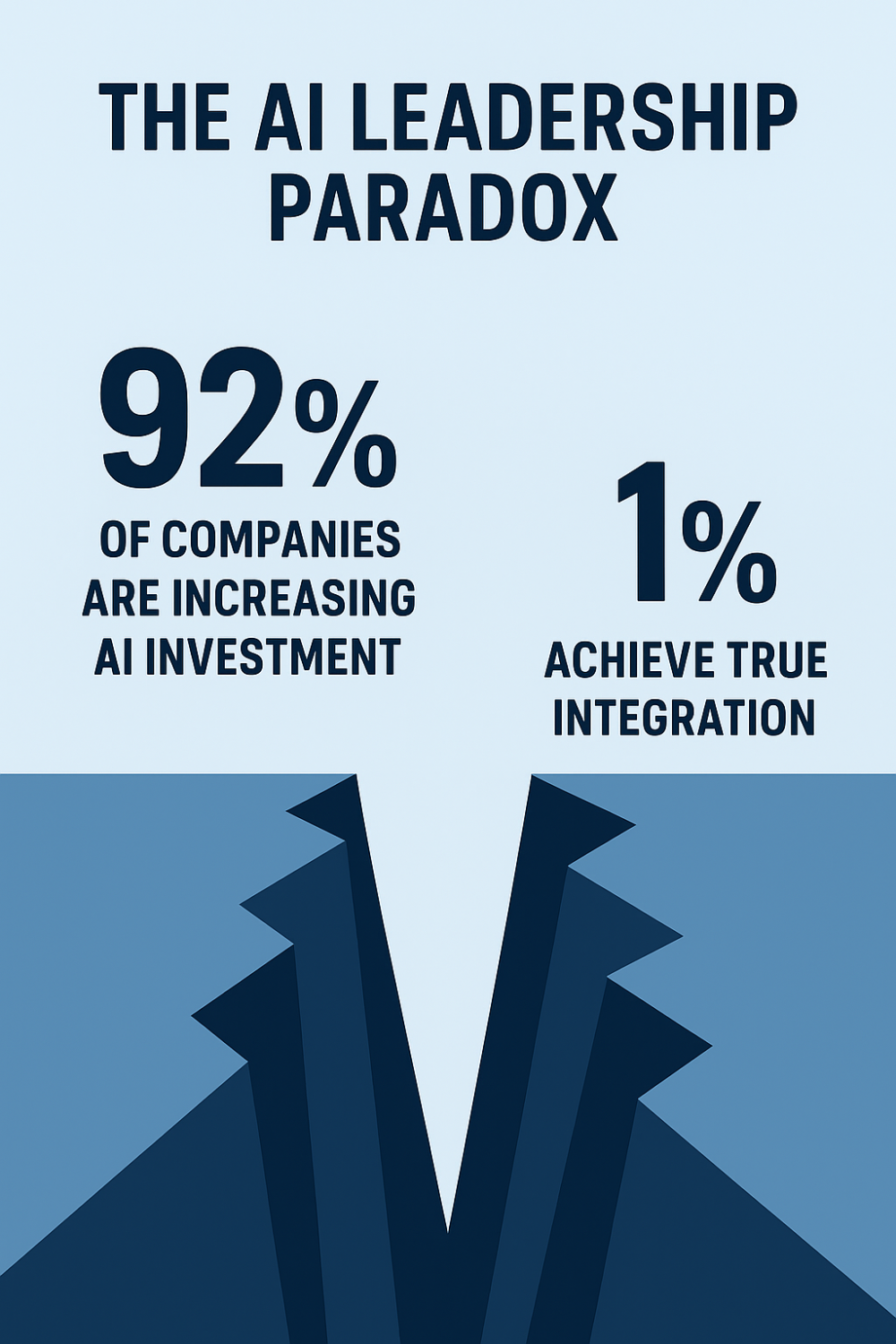
The enterprise landscape of 2025 is defined by a stark and widening chasm—a great disconnect between artificial intelligence ambition and actual achievement. On one side of this divide, investment and adoption are surging at an unprecedented rate. A recent McKinsey report reveals that an overwhelming 92% of companies plan to increase their AI investments over the next three years. This financial commitment is mirrored in adoption rates, with over 78% of business leaders reporting that their organizations have already deployed AI in at least one business function.
Yet, on the other side of the chasm lies a sobering reality. The same McKinsey study finds that a mere 1% of leaders describe their companies as “mature” on the AI deployment spectrum, a state where AI is fully integrated into workflows and drives substantial, measurable business outcomes.
This is not an isolated finding. Research from Qlik and ESG, published in February 2025, shows a similar gap: 94% of businesses are increasing spending on AI data readiness, yet only 21% have successfully operationalized the technology. Likewise, a 2024 Boston Consulting Group (BCG) report found that while 98% of companies are experimenting with AI, only 26% have managed to progress beyond the proof-of-concept stage to generate tangible value.
For the vast majority of organizations, this disconnect manifests as a state of perpetual "pilot purgatory." Promising AI initiatives are launched but never achieve scale, leaving a trail of disconnected experiments that fail to impact the bottom line. This phenomenon aligns perfectly with Gartner's "Trough of Disillusionment," a phase where initial hype and inflated expectations give way to frustration as implementations fail to deliver on their promises, leading to waning interest and abandoned projects.
This widespread failure, however, is not a technological one. The power of modern AI is undeniable. The investment-integration gap is a profound failure of leadership, strategy, and organizational change. The paradox is solvable, but it demands a fundamental shift in how executives perceive and lead AI initiatives—treating them not as isolated technology projects to be delegated, but as business-led, enterprise-wide transformations. This post will deconstruct the root causes of this systemic failure and provide an actionable playbook for leaders who aspire to join the 1% of truly AI-integrated enterprises.
The current state of affairs fosters a dangerous illusion of progress. The proliferation of AI tools and the high adoption rates create a veneer of activity that can mask deep-seated integration failures. Leaders observe the spending, see the dashboards light up with usage metrics, and assume value is being created. Yet, this confuses the act of procuring AI with the far more complex challenge of operationalizing it. The crisis is not a deficit of AI tools, but a deficit of AI-native business processes. As McKinsey's analysis makes clear, the true value of AI comes not from plugging in a new tool, but from fundamentally "rewiring how companies run".
Part I: Deconstructing the Paradox: The Three Pillars of AI Transformation Failure
The chasm between AI investment and integration is not the result of a single misstep but a systemic breakdown supported by three interconnected pillars of failure. Understanding these pillars is the first step toward dismantling them and building a foundation for success.
Pillar 1: Technology-First, Strategy-Last Thinking

The most common and critical error organizations make is approaching AI as a technology problem in search of a solution. The conversation often begins with, "We need a generative AI strategy," rather than, "How can we reduce customer service resolution time by 30%?" This technology-first mindset inevitably leads to a portfolio of disconnected, unscalable pilots that, even if technically successful, have no clear path to business value. Gartner projects that this very issue—unclear business value, alongside poor data quality and escalating costs—will cause 30% of all generative AI projects to be abandoned by 2025.
This flawed approach directly violates a fundamental principle of successful digital transformation identified by BCG: the 70-20-10 rule. AI leaders allocate their resources strategically, dedicating 70% to people and processes, 20% to technology and data infrastructure, and only 10% to the algorithms themselves. Most failing organizations invert this ratio, pouring the vast majority of their budget and attention into the technology and algorithms while neglecting the far more critical work of process redesign and change management.
This technology-centric view also creates a data foundation crisis. An AI model is only as effective as the data it is trained on, yet many companies invest in advanced AI tools without first preparing this essential fuel. The Qlik/ESG study highlights that while 94% of companies are increasing spending on AI-related products, they lack a structured plan for data readiness, a primary reason so many initiatives stall before they can be operationalized. This is not a minor oversight; it is a strategic failure to prepare the most critical prerequisite for success. Without a clean, accessible, and well-governed data ecosystem, even the most sophisticated AI engine will fail to produce reliable results.
Pillar 2: The Executive Leadership Gap

Effective AI implementation starts with a fully committed C-suite, and the common practice of delegating AI to the IT department is a recipe for failure.
AI is not merely a technology upgrade; it is a fundamental business transformation that requires top-down vision, strategic alignment, and committed leadership to succeed. Without this, AI efforts devolve into a series of fragmented, tactical experiments that lack the cohesion and strategic weight to drive enterprise-wide change.
This leadership gap is compounded by a preparedness paradox. While executives are eager to invest, a significant portion feels ill-equipped to lead the charge. More than half (54%) of senior business leaders admit they feel unprepared to navigate the complexities and rapid advancements of AI. This lack of confidence at the top creates a vision vacuum, preventing the formation of a cohesive, enterprise-wide AI strategy.
Furthermore, a dangerous perception gap exists between the C-suite and the operational reality of their organizations. Leaders significantly underestimate the extent to which their employees are already using generative AI. One survey found that C-suite leaders estimate only 4% of their workforce uses generative AI for at least 30% of their daily work; the actual self-reported figure from employees is three times higher, at 12%. This disconnect means that leaders are often unaware of how AI is organically permeating their business, leading to unmanaged risks, missed opportunities for scaling successful use cases, and a failure to provide necessary governance and support.
This lack of strategic oversight is reflected in outdated governance models. Many organizations attempt to apply traditional, compliance-focused governance frameworks to AI, which often act as a brake on innovation rather than an enabler. These models are ill-suited to the dynamic, probabilistic nature of AI. Compounding the issue is a lack of enforcement; only 47% of organizations strongly agree that their existing data governance policies are consistently enforced. This creates a high-risk environment where AI is adopted without sufficient guardrails, exposing the business to potential data breaches, biased outcomes, and regulatory penalties.
Pillar 3: The Change Management Deficit

The third, and arguably most critical, pillar of failure is the profound underestimation of the human element of AI transformation. AI adoption is a culture challenge as much as a technical one. The sociological challenges—reimagining workflows, upskilling talent, and driving organizational change—are often the most difficult part of the journey.
This challenge is rooted in a culture of workforce fear and resistance. A staggering 70% of employees report being worried about AI's potential impact on their profession and career. This anxiety, layered on top of general change fatigue from recent global disruptions, creates a work environment that is "afraid, unfamiliar, fearful, and...tired"—a culture that is fundamentally resistant to embracing new ways of working. When AI is perceived as a tool for headcount reduction rather than productivity improvement, this resistance intensifies, dooming adoption efforts before they begin.
This cultural deficit is directly linked to a tangible failure in talent investment. Less than one-third of companies have managed to upskill even a quarter of their workforce in necessary AI competencies. This creates a massive capabilities gap. Even if the perfect AI tool is deployed with a clear strategic vision, it will fail to deliver value if the workforce does not have the skills or confidence to use it effectively. This talent shortage is not a peripheral issue; research from Harvard Business Review confirms it is one of the primary barriers to organizational AI readiness.
These three pillars do not exist in isolation; they form a vicious cycle of failure that traps organizations in a state of arrested development. A technology-first approach, detached from clear business objectives, leads to pilot projects with no demonstrable ROI. This lack of measurable value makes it impossible for leaders to build a case for a broader strategic vision, reinforcing their risk aversion and treating AI as a cost center. Without a compelling strategic narrative and proven value, there is no impetus to invest in the difficult work of change management and upskilling. This failure to engage and empower the workforce ensures that subsequent AI projects will also fail to integrate, perpetuating a negative feedback loop that widens the gap between the 99% and the elite 1% who are caught in a virtuous cycle of success.
Part II: The Integration Imperative: What the 1% Do Differently

To escape the vicious cycle of failure, leaders must first understand what success looks like. The 1% of AI-mature organizations are not defined by the sophistication of their algorithms but by their mastery of integration. They have moved beyond isolated experiments to fundamentally rewire their operations, creating intelligent, adaptive enterprises that generate compounding value.
Defining Full Operational Integration
Full operational integration is a state of AI Systemization, where artificial intelligence is no longer a standalone project but is deeply and often invisibly embedded into the core systems and processes of the business. In this mature state, AI is not just a tool that employees use; it is an integral part of the operational fabric that actively drives measurable outcomes across multiple functions—from the factory floor to the customer service center—and continuously informs and refines broader business strategy.
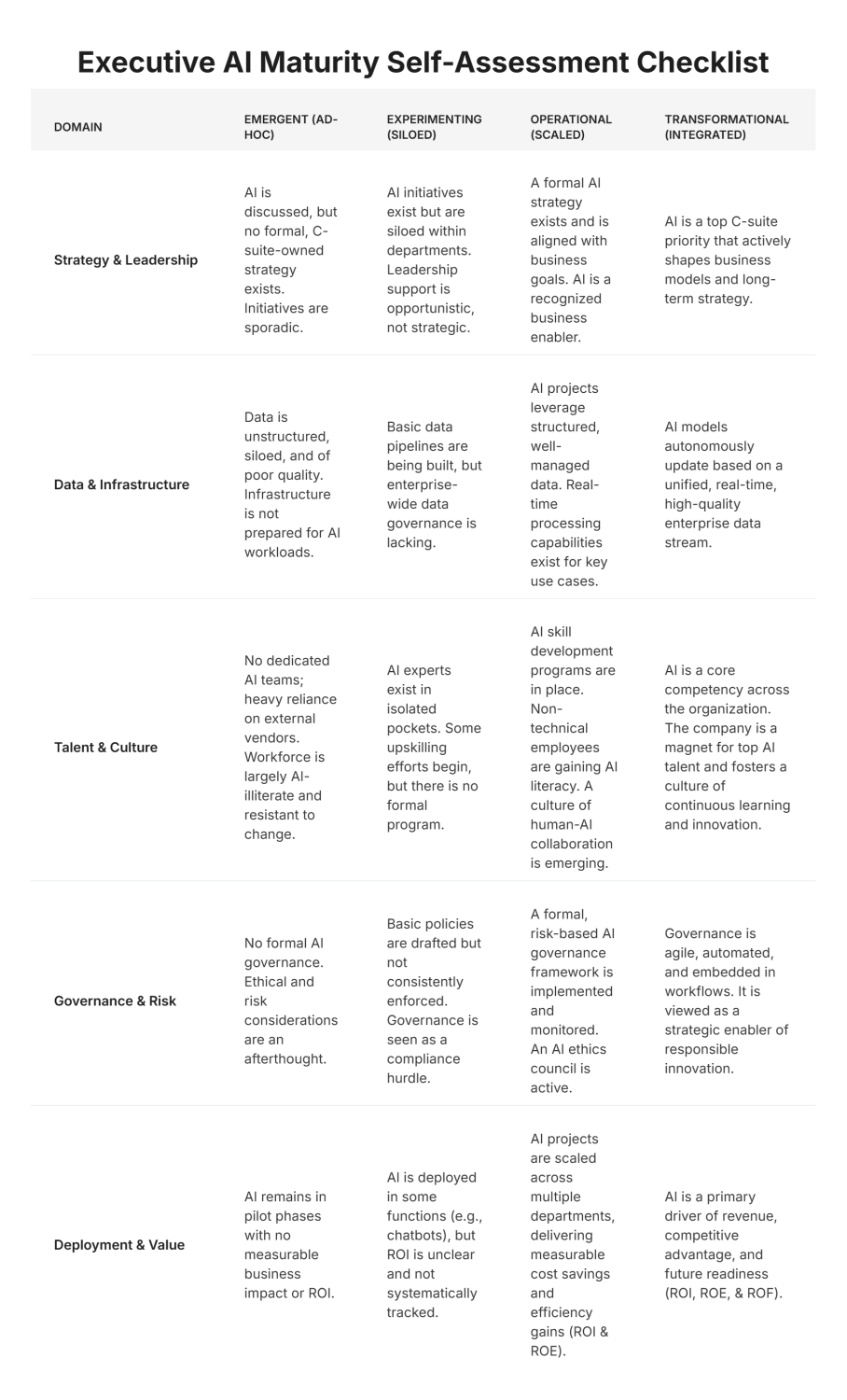
This represents the highest stage of a four-part AI maturity curve. At this level, AI performance monitoring is itself a core business process, not an IT task. Insights generated by AI systems are automatically shared across functional teams through integrated business management tools like Jira, Slack, or Microsoft Teams, ensuring cross-functional visibility and alignment. Governance frameworks are automated, and compliance is a built-in feature of the operational workflow. The shift is profound: AI ceases to be something the organization does and becomes part of what the organization is.
Case Studies in Excellence: A Look Inside the AI-Mature Enterprise
The abstract concept of full integration comes to life in the real-world strategies of leading global companies. These organizations provide a blueprint for overcoming the three pillars of failure by demonstrating a business-first strategy, deep commitment to change management, and a clear, top-down vision.
- Proctor & Gamble: Rewiring Manufacturing for a New Era
P&G exemplifies a business-first approach by deploying AI to solve core operational challenges. Instead of chasing trends, the company integrated AI and edge computing across more than 100 manufacturing sites to tackle two high-value problems: predictive maintenance to reduce downtime and real-time, computer-vision-based quality control for complex products like diapers. This is not a superficial application; it is a deep rewiring of the company's production nervous system, demonstrating a clear focus on tangible business outcomes over technological novelty.
- Toyota: Democratizing AI on the Factory Floor
Toyota directly confronts the change management deficit by empowering its own factory workers—the people closest to the operational challenges—to develop and deploy machine learning models. Using Google Cloud's AI platform, Toyota democratized AI, turning its workforce into active participants in the transformation rather than passive recipients of it. This collaborative approach fostered a culture of ownership and innovation, resulting in a quantifiable saving of over 10,000 man-hours annually. It is a masterclass in building an AI-ready culture from the ground up.
- UPS: The System-Wide Digital Twin
UPS's strategy represents the pinnacle of top-down, visionary leadership. The company is building a "digital twin" of its entire global distribution network—a dynamic, real-time virtual replica of every physical asset, process, and system. This is not a point solution; it is a complete re-architecture of the business for an AI-native world. By simulating the entire logistics ecosystem, UPS can move from reactive problem-solving (e.g., responding to an ice storm) to proactive, predictive optimization, rerouting package flow and scheduling vehicle maintenance before disruptions occur. This initiative showcases a profound understanding that true transformation requires reimagining the enterprise as a single, intelligent system.
- EchoStar: Scaling Value Across the Enterprise
EchoStar demonstrates the critical final step that eludes most companies: scaling beyond the initial pilot. After a successful proof-of-concept, its Hughes division did not stop. It created 12 new production applications that embedded AI across sales (automated call auditing), customer service (retention analysis), and field operations (process automation). This cross-functional deployment is projected to save 35,000 work hours and showcases the "multiplier effect" that comes from a scalable, repeatable AI strategy.
The Compounding Returns of an Integrated AI Ecosystem

The true, transformative power of AI is unlocked not when it optimizes a single task, but when it connects and enhances processes across the entire enterprise. This creates an AI Multiplier Effect, where the synergistic value of integrated systems is far greater than the sum of its siloed parts. When an AI-driven insight from the marketing team about a shift in consumer demand is automatically fed into the supply chain's forecasting models, the entire organization becomes more agile and responsive. This cross-functional deployment breaks down departmental silos and creates a holistic, intelligent enterprise capable of sensing and responding to market changes as a unified organism.
This integration also ignites a powerful Data Flywheel, the engine of compounding competitive advantage in the AI era. Every interaction an AI-integrated system has with a customer, a supplier, or an internal process generates new, proprietary data. This data is immediately used to refine and improve the underlying AI models, which in turn leads to better, more effective future interactions. This creates a virtuous, self-improving cycle. This continuous feedback loop is the foundation of a durable Data Moat—a proprietary data asset that becomes richer, more nuanced, and more valuable with every transaction, making it nearly impossible for competitors to replicate. This flywheel generates powerful network effects within the enterprise, where each new AI application makes the entire ecosystem smarter and more valuable.
The success of these incumbent leaders reveals a crucial shift in the competitive landscape. In an era where powerful foundational AI models are becoming increasingly accessible and commoditized, the source of durable advantage is moving away from simply possessing the best algorithm. The true differentiator is the mastery of integration. The 1% are not necessarily "AI companies" in the traditional sense; they are established leaders who have learned how to expertly weave AI into their unique, complex, and often decades-old operational fabric. They use AI to enhance their existing competitive advantages—P&G's manufacturing scale, Toyota's production system, UPS's logistics network—creating value that a pure-tech startup, lacking the deep domain knowledge and proprietary operational data, cannot easily replicate. The competitive battleground has decisively shifted from the research lab to the "last mile" of enterprise implementation.
Part III: The 2025 AI Leadership Playbook: A Framework for Action
Navigating the AI paradox requires more than just investment; it demands a deliberate, structured, and holistic approach to transformation. The following four-part playbook provides a clear framework for executives to move their organizations from a state of fragmented experimentation to one of strategic, scaled integration.
1. Vision & Strategy Alignment: From Random Acts of AI to a Unified Roadmap

The first and most critical step is to halt the proliferation of uncoordinated, bottom-up AI experiments. True transformation begins when the C-suite definitively answers the question of "why." This requires moving beyond tactical deployments and establishing a clear, enterprise-wide strategic vision for AI.
Two actionable frameworks can guide this process:
- Stanford's 4-Step AI Strategy Framework: This provides a logical sequence for developing a robust strategy. It begins with (1) Define the problem, ensuring every initiative is tied to a genuine business opportunity. It then moves to (2) Consider the timeline, assessing organizational readiness and market timing. The third step is to (3) Create a roadmap, which outlines implementation steps, required support, and the key performance indicators (KPIs) for measuring success. Finally, it requires leaders to (4) Build the three pillars of a strong foundation: a coherent data strategy, a clear algorithm strategy, and a scalable infrastructure strategy.
- The AI Strategy Canvas: This is a powerful one-page tool for creating organizational consensus. The canvas forces leadership teams to align on nine interconnected building blocks for each AI initiative, including the Target Audience, Company Voice and Values, Products/Services to be enhanced, the specific Role of the AI (e.g., analyst, assistant), and the desired Outputs. By visualizing how a project comes together, it ensures that all stakeholders—from marketing to IT to legal—share a common understanding and set of expectations from the outset.
With a clear strategy in place, implementation should follow a phased rollout to manage risk while building momentum. This staged approach typically moves from a Proof of Concept (POC) to validate technical feasibility, to a Pilot in a single business unit to measure performance and gather feedback, to a Minimum Viable Product (MVP) that is robust and ready for broader adoption, and finally to a full Enterprise Rollout. Crucially, governance, change management, and value tracking must be embedded into each phase, not treated as afterthoughts.
2. Building a Hybrid Expertise Network: The AI Center of Excellence (CoE)
To overcome the fragmentation that plagues most AI efforts, organizations must centralize key functions to standardize best practices, govern risks, and drive scalable growth. The most effective structure for this is an AI Center of Excellence (CoE).
The optimal operating model for a CoE is the "hub-and-spoke" design. A central "hub" team is responsible for setting the enterprise-wide AI strategy, developing common infrastructure and platforms, and establishing governance standards and ethical guardrails. This central team ensures consistency and efficiency. However, to maintain agility and business alignment, "spokes" of dedicated AI talent are embedded directly within business units. These spoke teams report functionally to their business unit leaders but have a dotted line to the central CoE, allowing them to solve local problems while leveraging centralized resources and adhering to enterprise standards.
Assembling the right talent for the CoE is paramount and extends far beyond hiring data scientists. A modern, multidisciplinary AI team requires a blend of expertise: AI Strategists to align projects with business goals, Data Engineers to build robust data pipelines, Business Analysts to translate needs into technical requirements, AI Ethicists and Compliance Officers to manage risk, and Change Management Specialists to drive adoption.
To build this talent pipeline sustainably, organizations can adopt BCG's holistic "Anticipate, Attract, Develop, Engage" model. This framework guides companies to Anticipate future skill needs through strategic workforce planning, Attract top talent with a compelling value proposition, Develop internal capabilities through robust upskilling and continuous learning programs, and Engage employees by creating a culture that empowers them to collaborate effectively with AI.
3. A Revolution in Measurement: Beyond Simple ROI
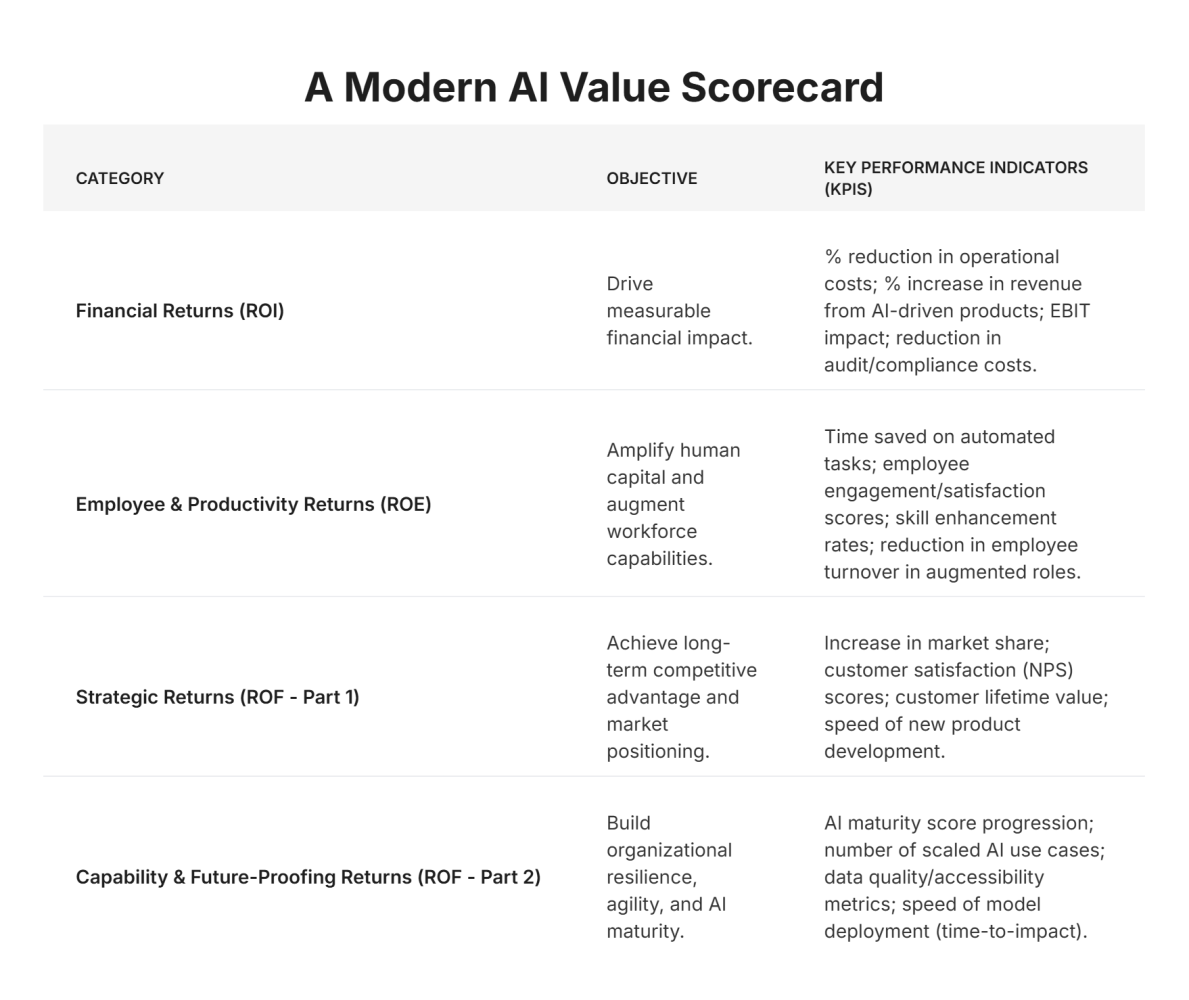
A primary reason AI initiatives stall is the inability to prove their value using outdated measurement models. Traditional ROI calculations, focused solely on direct cost savings, fail to capture the multifaceted impact of a transformative technology like AI. Leaders need a new language and a more sophisticated framework to articulate the true return on their AI investments.
Gartner's AI Value Pyramid provides a powerful, C-suite-friendly model that assesses value across three critical layers. This framework expands the definition of "return" to create a holistic view:
- Return on Investment (ROI): This is the foundational layer, encompassing the traditional, tangible financial metrics. It answers the question: "Is this initiative making or saving us money?"
- Return on Employee (ROE): This layer measures how AI empowers and amplifies the human workforce. It reframes AI as a tool for augmentation, not just automation, and answers the question: "Is this initiative making our people better, smarter, and more engaged?"
- Return on the Future (ROF): This is the most strategic layer, assessing how AI investments build long-term organizational capabilities. It measures the increase in the company's adaptability, resilience, and capacity for future innovation, answering the question: "Is this initiative making our organization more future-ready?"
To make this framework actionable, leaders can implement a balanced scorecard that defines clear KPIs for each category, drawing on models from both Gartner and ISACA.
4. Evolving Governance: From Compliance Cop to Competitive Catalyst
In the AI era, governance must evolve from a reactive, compliance-focused function into a proactive, strategic enabler. A modern AI governance framework does not stifle innovation; it accelerates it by building trust, managing risk, and creating the guardrails necessary for responsible scaling. This transformation turns governance from a perceived cost center into a source of genuine competitive advantage.
The key components of an effective and agile AI governance framework include:
- A Strong Strategic Foundation: This begins with clear C-suite accountability and board-level oversight. It requires the establishment of organization-specific AI principles aligned with corporate values and a tiered governance structure—for example, a strategic board committee for setting risk appetite, an executive-level AI Ethics Council for oversight, and an operational committee for routine reviews.
- A Risk-Based Tiering System: Not all AI applications carry the same level of risk. An effective framework classifies use cases into tiers (e.g., low, medium, high risk) and applies proportionate controls. This prevents governance from becoming a bottleneck for low-risk innovation while ensuring high-impact systems receive appropriate scrutiny.
- Full Lifecycle Oversight: AI governance cannot be a one-time check at the beginning of a project. It must cover the entire model lifecycle—from design, data sourcing, and training to validation, deployment, continuous monitoring, and retirement. This approach is essential for managing "model sprawl" and ensuring that models do not degrade or drift over time.
- Automated and Transparent Processes: To govern AI at scale, manual processes are insufficient. Leading organizations use automated tools for continuous model monitoring, automated compliance checks against regulatory frameworks, and centralized model registries that provide a single source of truth for all AI assets, ensuring transparency and accountability.
Part IV: The Competitive Advantage Window is Closing
While the path to AI maturity is challenging, the strategic imperative to embark on the journey has never been greater. A consensus is emerging among industry analysts that the window of opportunity to secure a significant early-adopter advantage is rapidly closing. The decisions made—or not made—in the coming months will likely determine the competitive hierarchy for the next decade.
The Urgency of Now: The 12–18 Month Window
Expert analysis suggests that the next 12 to 18 months represent a critical strategic window for companies to move decisively on AI integration. During this period, the market is maturing, foundational models are stabilizing in their capabilities, and the tools required to deploy AI effectively across sectors are becoming more accessible and robust. Organizations that use this time to build the strategic, operational, and cultural foundations for scaled AI will pull away from the pack.
Those that hesitate risk being left behind in what is being termed a “Divergent Future.” In this scenario, the economy splits into two classes of companies: AI leaders who leverage their integrated capabilities to accelerate innovation and efficiency exponentially, and laggards who find themselves structurally disadvantaged, struggling to compete on cost, speed, and customer experience. The risk of waiting is no longer about missing incremental gains; it is about facing systemic obsolescence.
The Coming AI Standardization and the Shift in Value
The history of technology shows that every major breakthrough eventually becomes commoditized, and AI will be no exception. As algorithms become more powerful and accessible, and as open-source models continue to erode the dominance of proprietary ones, the mere possession of a sophisticated AI model will cease to be a source of competitive differentiation. It will become table stakes—a utility that every serious competitor is expected to have.
This standardization will trigger a fundamental shift in the locus of competitive advantage. When every company has access to a similar AI engine, the new battleground becomes how uniquely and effectively that engine is applied. The key differentiators will no longer be the models themselves, but rather the proprietary data used to train them and the unique business processes into which they are embedded. As external data becomes more accessible to all, the value of a company's unique, proprietary insights—gleaned from direct customer interactions, ethnographic research, and internal operations—will become paramount.
Building Sustainable AI Moats for the Next Decade
In this new landscape, the ultimate goal of an AI strategy is to build a durable "economic moat"—a sustainable competitive advantage that protects market share and profitability from competitors. AI acts as a powerful accelerant for traditional moats; for example, it strengthens network effects by making a product smarter with each new user, and it increases switching costs by deeply personalizing the user experience over time.
However, the most powerful and defensible moats in the AI era will be those that are AI-native. Two stand out as particularly critical:
- Data Moats: A true data moat is not built by simply accumulating vast amounts of data. It is constructed by creating continuous, proprietary feedback loops. In this model, agentic AI systems engage in interactions that generate unique, context-rich data. This data is immediately used to improve the agent's performance, which in turn enables better future interactions, generating even richer data. This creates a compounding, self-improving cycle that is impossible for a competitor to replicate without access to the same stream of real-world interactions.
- Process Moats: This moat is formed by encoding a company's unique, proprietary business logic and institutional knowledge into AI agents. This transforms tacit knowledge—the "secret sauce" of how a company operates—from something that resides in the minds of key employees into a scalable, executable, and continuously improving asset. A competitor might be able to see the results of an AI-optimized process, but they cannot easily replicate the years of accumulated wisdom and refined decision-making frameworks embedded within the agents themselves.
This leads to a final, crucial paradox of the AI era. While the base technology of AI is becoming standardized and more accessible, its application is creating deeper, more defensible moats than ever before. The ease of getting started with an AI tool masks the extreme difficulty of catching up to an integrated leader. A new market entrant can access the same powerful LLM as UPS, but it cannot access the decades of proprietary logistics data and refined operational processes that UPS uses to fuel its digital twin. As AI becomes easier to adopt, a company's existing proprietary assets—its data, its processes, its domain expertise—become exponentially more valuable. This creates a "rich get richer" dynamic, widening the chasm between the leaders who are building these compounding moats and the laggards who are still stuck in pilot purgatory.
Conclusion: The Leadership Imperative for 2026 and Beyond
The great AI disconnect is, at its core, a testament to a failure of leadership. The chasm between the 99% of companies investing in AI and the 1% successfully integrating it is not defined by access to technology, but by the presence of a clear vision, a strategic roadmap, and the organizational courage to rewire the enterprise for a new reality. The journey from pilot purgatory to full integration is not an IT project; it is a CEO-level imperative that demands sustained focus and a willingness to challenge long-held assumptions about how work gets done.
For executives ready to lead this transformation, the first step is an honest assessment of their organization's current state. The following checklist provides a high-level framework for leaders to self-diagnose their AI maturity and identify the most critical gaps that need to be addressed.
Looking toward 2026, the vision for the AI-integrated enterprise is clear. It is an organization that is not just using AI, but is an intelligent system—agile, adaptive, and continuously learning.
It is a workplace where human talent is amplified, not replaced; where decision-making is data-driven and evidence-based at every level; and where innovation is not a sporadic event but an emergent property of its AI-native operating model. The path is challenging, but for the leaders who successfully navigate it, the reward is not just a competitive edge, but a fundamental redefinition of what their organization can achieve.
Is your organization stuck in pilot purgatory? Alpha Technical Solutions can help you bridge the gap from investment to integration.
Sources
- https://addepto.com/blog/15-top-ai-integration-companies-in-2025-comprehensive-guide-to-ai-implementation-strategies/
- https://athena-solutions.com/ai-governance-framework-2025/
- https://innovationsoftheworld.com/ups-revolutionizing-logistics-with-tomorrows-technology-today/
- https://isg-one.com/articles/the-impact-of-ai-on-enterprise-networks--a-blueprint-for-success-with-advisory-support
- https://jdmeier.com/ai-coe/
- https://journal.esrgroups.org/jes/article/download/5434/3912/10017
- https://sirma.com/insights/aligning-ai-initiatives-with-business-goals-from-vision-to-roadmap.html
- https://sloanreview.mit.edu/article/why-ai-will-not-provide-sustainable-competitive-advantage/
- https://sloanreview.mit.edu/series/how-to-maximize-the-business-value-of-generative-ai/
- https://sloanreview.mit.edu/video/getting-payback-from-generative-ai/
- https://sof.to/blog/posts/unveiling-gartner-s-ai-maturity-model-strategies-for-modern-businesses
- https://uhy-us.com/insights/news/2024/august/key-components-of-an-ai-governance-program
- https://www.deloitte.com/us/en/what-we-do/capabilities/applied-artificial-intelligence/content/state-of-generative-ai-in-enterprise.html
- https://www.gartner.com/en/articles/take-this-view-to-assess-roi-for-generative-ai
- https://www.interactionic.com/critical-insights-ai/
- https://www.investopedia.com/ask/answers/05/economicmoat.asp
- https://www.isaca.org/resources/news-and-trends/newsletters/atisaca/2025/volume-5/how-to-measure-and-prove-the-value-of-your-ai-investments
- https://www.kearney.com/service/digital-analytics/article/new-hbr-article-explores-how-business-leaders-can-turn-ai-from-a-cost-center-into-a-value-catalyst
- https://www.leanix.net/en/wiki/ai-governance/ai-strategy
- https://www.lxt.ai/path-ai-maturity/
- https://www.mckinsey.com/~/media/mckinsey/business%20functions/quantumblack/our%20in/quantumblack/our-insights/the-state-of-ai
- https://www.microsoft.com/en-us/microsoft-cloud/blog/2025/07/24/ai-powered-success-with-1000-stories-of-customer-transformation-and-innovation/