Executive Summary: Talent is the Rate-Limiting Factor for AI Transformation
In 2025, the primary constraint on realizing the full economic potential of artificial intelligence is no longer the technology itself, but the acute scarcity of specialized human talent required to build, deploy, and govern it. While investment in AI continues to accelerate, with over 90% of companies planning to increase their AI budgets, a staggering 46% of leaders cite a lack of skilled personnel as the single greatest barrier to adoption. This talent deficit has become the rate-limiting factor for innovation and growth.
The global AI talent market is in a state of structural imbalance, defined by a projected hiring gap that could see demand for technology professionals outpace supply by a factor of two to four by 2027.
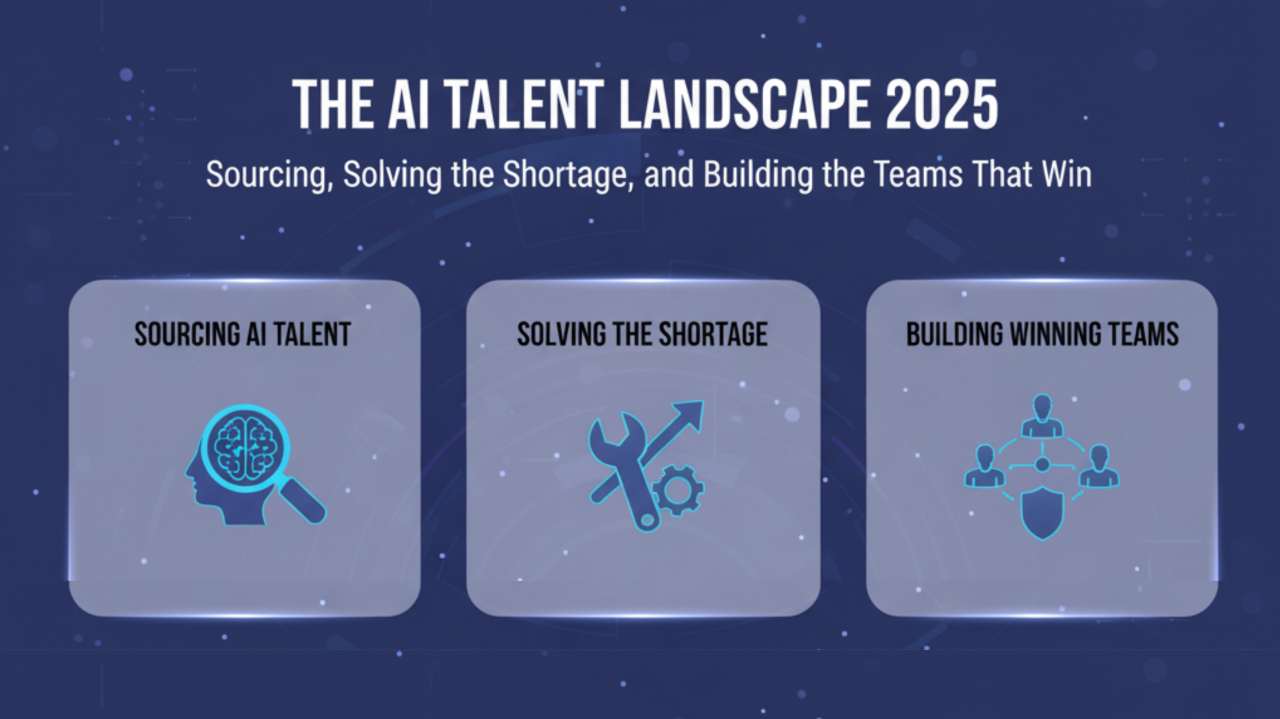
This article provides a comprehensive analysis of this critical landscape. It examines the scope of the global shortage and its economic consequences, defines the new hybrid skills mix required to build winning teams, and outlines a modern playbook for sourcing, retention, and strategic workforce planning. For business leaders, technologists, and HR professionals, understanding and navigating this new reality is not just an operational challenge—it is a strategic imperative for survival and success in the age of AI.
The Scope of the Shortage: A Global Talent Deficit
The current AI talent shortage is not a cyclical trend but a deep, structural market shock driven by an unprecedented collision of explosive demand and constrained supply. The data paints a clear picture of a crisis that is global in scope and profound in its business implications.
The Data-Driven Reality of the AI Talent Gap
The global AI talent market is now unequivocally a seller's market, defined by intense competition for a finite pool of experts. This has created a projected 50% hiring gap for 2025, where for every two AI-related roles a company seeks to fill, only one qualified candidate is available. This scarcity is the result of a massive surge in demand; global job postings for AI and machine learning talent skyrocketed by 61% in 2024, a rate of growth that dwarfs the 1.4% average for all other jobs combined.
The advent of powerful generative AI models has acted as a powerful accelerant. In the United States alone, job postings explicitly requiring "generative AI" skills quadrupled in a single year, jumping from 16,000 to over 66,000. This surge reflects a fundamental shift where nearly one in four new technology job ads now asks for AI skills, double the number from 2022.
This talent war is being fought most intensely between the United States and China. According to the 2024 Stanford AI Index, the U.S. remains the leader in producing top AI models and attracting private investment, securing $67.2 billion in 2023. However, China is rapidly closing the performance gap on key benchmarks and now leads the world in both AI patent filings and total research output, creating a fierce geopolitical competition for top-tier talent.
The underlying cause of this crisis can be traced through a clear sequence of events. The public release of highly capable generative AI models in 2022 and 2023 created a "Big Bang" moment for commercial applications. This ignited a massive surge in private investment, with funding for generative AI specifically octupling to $25.2 billion. This influx of capital fueled an explosive demand for highly specialized roles that barely existed a few years prior. This demand wave crashed against a supply pipeline—universities and PhD programs—that operates on a much slower, more traditional timescale, creating a severe "experience bottleneck". The outcome is a classic supply-demand shockwave resulting in a structural market imbalance, project delays, and hyper-inflated compensation.
The Business Impact: More Than an HR Problem
The consequences of this talent deficit extend far beyond the HR department, directly impacting strategic execution, financial performance, and a company's capacity to innovate.
- Project Delays and Lost Innovation: The talent shortage is a direct brake on progress. A recent McKinsey survey found that 60% of companies identify the scarcity of tech talent as a key inhibitor of their digital transformation efforts. This translates into delayed product launches, slower adoption of efficiency-boosting AI tools, and a tangible loss of competitive advantage as more agile, well-staffed competitors pull ahead.
- Hyper-Inflation of Salaries: The fierce competition for a limited number of qualified professionals has triggered unprecedented salary inflation. In top U.S. tech hubs like San Francisco, a mid-career machine learning engineer now commands a base salary between $140,000 and $180,000. At the highest levels, the compensation is even more dramatic; according to Levels.fyi, Staff-level AI specialists at leading tech firms can now earn total compensation packages exceeding $900,000. This creates immense cost pressure and makes it nearly impossible for smaller companies to compete for top-tier talent.
- Sector-Specific Crises: The pain is most acute in industries where AI is not a luxury but a core component of business operations.
- Fintech: The demand for AI talent in fintech is exceptionally high, as firms rely on AI for critical functions like real-time fraud detection, algorithmic trading, and credit risk management. However, they struggle to find professionals who possess the rare blend of deep engineering skills, data stewardship, and fluency in complex regulatory environments.
- Healthcare: In life sciences, the demand for AI skills is described as "unprecedented". AI is revolutionizing drug development, medical diagnostics, and personalized patient care. This requires a unique, interdisciplinary professional who combines technical expertise in machine learning with a deep understanding of biology, genomics, and clinical workflows—a combination that is exceptionally rare.
- Manufacturing and Design: According to a report from Autodesk, AI fluency is rapidly becoming a baseline expectation across architecture, engineering, and manufacturing. Job listings mentioning AI in these "Design and Make" industries surged by over 120% in 2024, as companies seek to leverage AI for everything from generative design to supply chain optimization.
What Roles You’ll Need to Fill: The Anatomy of a Modern AI Team
Successfully integrating AI requires a fundamental shift in team building. The era of relying on a single "AI guru" or a siloed team of data scientists is over. Winning in 2025 means assembling a sophisticated, cross-functional unit of specialists who can collectively bridge the gap between raw technology, business value, and responsible governance. As I've discussed in a previous post, the most critical roles are often those that translate and connect, ensuring that technical efforts are aimed squarely at solving real business problems.
Central to this new structure is the rise of the "business translator"—an individual who understands both the technical capabilities of AI and the strategic needs of the business. This person ensures that the "what" and "why" of business objectives are effectively communicated into the "how" for technical teams, preventing expensive and time-consuming misalignments. This function is embodied in several of the new, critical roles that define the modern AI team, such as the AI Product Manager, who must translate expensive experiments into revenue-generating products, and the AI Architect, who designs the end-to-end technical blueprint. Other essential roles include the Prompt Engineer, who crafts the inputs that guide AI models, and the AI Ethicist, who develops the governance frameworks to ensure fairness and compliance.
The following table breaks down these and other key roles that form the vanguard of a successful AI initiative, detailing not just what they do, but why they have become indispensable in the current landscape.
AI Talent - Key Roles For Your Organization
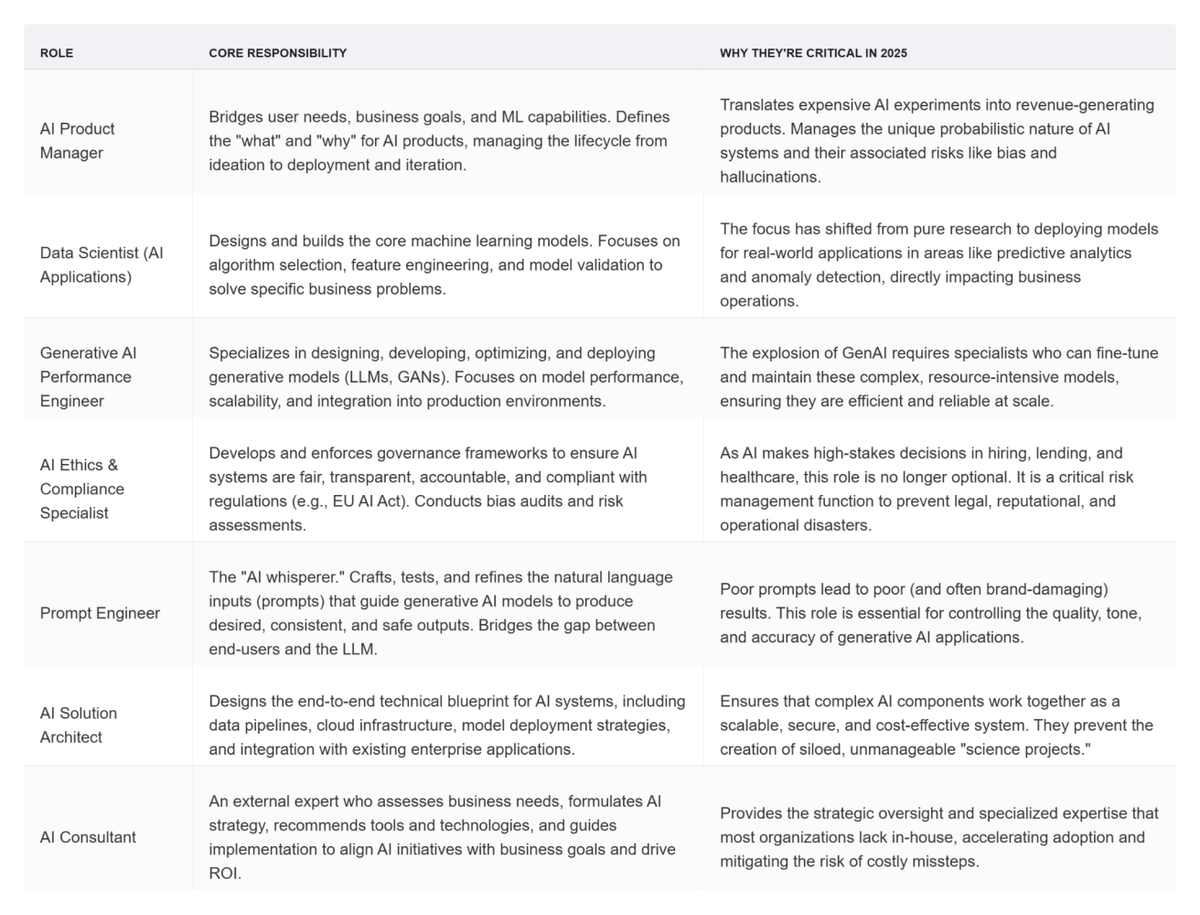
The evolution of this team structure is a direct reflection of AI's journey from a niche R&D experiment to a core, enterprise-wide business function. In the early days of adoption, teams were dominated by technical roles like Data Scientists, focused on building models in isolated labs. However, as AI—and particularly generative AI—moves into production and customer-facing applications, its potential impact on business operations, legal risk, and brand reputation grows exponentially.
This maturation creates two non-negotiable organizational needs: governance and translation. The first, governance, arises from the necessity to manage legal exposure from new regulations like the EU AI Act and to mitigate the ethical risks of bias and unfairness. This gives birth to the AI Ethics & Compliance Specialist, a role dedicated to risk management. The second need, translation, stems from the imperative to ensure that these complex and expensive technical projects deliver a tangible return on investment. This elevates the importance of roles like the AI Product Manager, who translates business needs into technical requirements, and the AI Consultant, who aligns the entire AI strategy with C-suite objectives. The modern AI team, therefore, is defined by this new layer of professionals focused on managing risk and creating value.
Smart Sourcing: The Modern Playbook for 2025
In a market defined by extreme talent scarcity, traditional, reactive recruiting methods are no longer viable. Winning the war for AI talent requires a strategic, proactive, and technology-enabled approach to sourcing. The modern playbook is built on three core pillars: leveraging AI to find talent, prioritizing skills over credentials, and building a sustainable pipeline for the future.
Leveraging AI to Hire AI Talent

The most effective way to find top AI professionals is to use the very technology they specialize in. A new generation of AI-driven sourcing platforms—such as hireEZ, SeekOut, and Fetcher—has revolutionized talent acquisition. These tools go far beyond simple keyword searches on job boards. They use sophisticated algorithms to scan hundreds of millions of public profiles across professional networks, code repositories, and academic publications to identify candidates who possess the specific skills and attributes required for a role.
The primary advantage of these platforms is their ability to enable programmatic recruitment and passive talent pool mining. The most valuable AI professionals are rarely active job seekers; they are already employed and highly valued. AI sourcing tools allow recruiters to identify these passive candidates and engage them with personalized, long-term nurture campaigns. This shifts the recruiting paradigm from waiting for applications to proactively building relationships with the best talent in the market.
The Strategic Imperative of Skills-First Hiring
The intense competition for AI talent has exposed the limitations of relying on traditional credentials like university degrees or a specific number of years of experience. These rigid requirements often create an artificial "paper ceiling" that filters out highly skilled individuals who have gained their expertise through non-traditional paths, such as intensive bootcamps, online certifications, or significant open-source contributions.
A skills-first hiring approach dismantles these barriers. Instead of focusing on pedigree, it prioritizes a candidate's demonstrated abilities. This is achieved through practical, hands-on evaluations, such as project-based assessments, portfolio reviews, and technical challenges that mirror the actual work to be performed. This methodology has two profound benefits. First, it dramatically widens the available talent pool, giving access to a more diverse set of candidates who are judged on what they can do, not where they studied. Second, it has been shown to improve the quality of hires and reduce bias in the selection process.
Building Your Own Talent Pipeline
While smart sourcing can address immediate needs, long-term success in the AI era depends on building a sustainable talent pipeline rather than perpetually competing in the open market. This requires forging deep, strategic partnerships with educational institutions.
Leading technology companies are already pioneering this model. Programs like IBM's Cognitive Computing Initiative with the University of Illinois and Microsoft's Datacenter Academy, which partners with local community colleges, are prime examples. In these collaborations, the company works directly with the academic institution to co-develop curricula, provide access to cutting-edge tools and platforms, and offer students the opportunity to work on real-world projects.
This creates a direct, reliable bridge from education to employment, producing graduates whose skills are precisely aligned with the company's needs and creating a powerful, long-term competitive advantage. The University of Arizona's AI Core program is another model, offering students immersive internships that pair with coursework to ensure they graduate with practical, career-ready skills.
The strategic logic behind these modern sourcing methods represents a complete inversion of the traditional recruiting funnel. Historically, hiring began with a wide top-of-funnel composed of a large volume of active applicants from job boards, which was then progressively narrowed. In today's AI talent market, that top-of-funnel is effectively empty.
Winning organizations have flipped the model. They begin with a highly targeted, narrow search for top-tier passive candidates identified through AI-powered tools. They then strategically widen this small, high-quality pool by applying skills-first criteria, which allows them to include exceptional talent from non-traditional backgrounds who would have been screened out by legacy systems. Finally, to ensure their long-term viability, they invest in building their own future top-of-funnel through deep university partnerships. This marks a fundamental shift from passively filtering a large, low-quality pool to actively hunting for a small, high-quality one and then systematically expanding it.
Building a Culture That Retains AI Champions: Beyond the Paycheck

In a market where top AI talent can command staggering salaries, financial compensation is merely the price of entry. Long-term retention is won or lost based on culture, growth opportunities, and the intellectual challenge of the work itself. Companies that succeed in keeping their best AI minds are those that invest strategically in their people's development and create an environment where innovation can flourish.
Upskilling and Reskilling as a Strategic Imperative
The most critical element of any AI talent retention strategy is a deep and authentic commitment to continuous learning. With the pace of change in AI, skills can become obsolete in a matter of months, and top professionals will not stay at an organization where they feel their expertise is stagnating. Recognizing this, 85% of employers now plan to prioritize upskilling their workforce. This is not just a benefit; it is a strategic necessity to fill emerging AI roles from within and provide clear pathways for growth.
Leading corporations have demonstrated a clear return on investment from their large-scale upskilling initiatives:
- Amazon launched a massive program to train over 100,000 employees in AI and machine learning, an investment that directly contributed to a 15% increase in operational efficiency.
- Microsoft has leveraged its own AI-driven training platforms to accelerate the acquisition of new skills by 30%, which has been correlated with a 15% increase in revenue in participating business units.
- Firms like KPMG and PwC have implemented mandatory, firm-wide AI literacy programs ("GenAI 101" and "PowerUp," respectively) to establish a baseline of AI understanding across their entire workforces, ensuring that everyone from consultants to partners can speak the language of AI and identify opportunities for its application.
Creating a Culture of Purposeful Experimentation

Top AI talent is driven by the desire to solve complex, meaningful problems. A culture that not only permits but actively encourages experimentation is a powerful retention magnet. This requires creating an environment of psychological safety, where "failure" is reframed as a valuable learning opportunity. For example, when Johnson & Johnson made cuts to its AI projects, it was not seen as a setback but as a strategic decision to double down on the 20% of initiatives that were showing the most promise.
This culture can be institutionalized. Google, for instance, has Google Labs, a dedicated public-facing home for AI experiments that signals a deep organizational commitment to exploration. To be effective, however, experimentation must be paired with "institutional memory"—a systematic process for capturing the hypotheses, results, and learnings from every test. This prevents teams from re-testing the same failed ideas and ensures that knowledge is compounded over time, creating a true learning organization.
Retention Through Clear Career Pathways
Exceptional talent will inevitably leave if they cannot see a clear path for advancement. Organizations must move beyond ad-hoc roles and define transparent, structured career pathways for their AI professionals. This involves creating distinct tracks for both technical and managerial advancement.
An individual contributor should be able to see a path from a junior data scientist role to a senior technical position like a Principal Data Scientist or Senior Data Architect, with increasing scope and influence. Similarly, those with leadership aptitude should have a clear transition path into management roles like a Technical Program Manager, with a route to higher executive positions. Crucially, these pathways must be directly linked to the organization's upskilling programs, demonstrating to employees exactly how the acquisition of new skills translates into tangible career progression.
A critical, often-overlooked threat underscores the importance of these retention strategies. The immediate business imperative is to use AI to automate tasks and drive efficiency. However, a significant second-order risk emerges from this push. Gartner has termed this phenomenon "AI lock-in". As employees become increasingly dependent on AI to perform core functions, their own foundational skills in areas like analysis, coding, and critical problem-solving can begin to atrophy.
Over time, the organization risks losing the very human expertise required to validate, correct, or improve upon the AI's outputs. The human "backup system" and the capacity for grassroots innovation disappear. Gartner predicts that by 2030, half of all enterprises will face irreversible skill shortages in at least two critical roles due to this unchecked automation. Therefore, the most sophisticated retention and upskilling strategies are not merely about employee satisfaction; they are a crucial defense against long-term strategic vulnerability, ensuring a symbiotic human-AI partnership rather than a dependency that leads to organizational deskilling.
Addressing Diversity, Equity & Inclusion: Engineering Fairness

The integration of AI into the hiring process presents a profound duality. Used thoughtfully and with rigorous oversight, AI can be a powerful tool for mitigating the unconscious biases that have long plagued human-led recruitment. Used carelessly, it can become a high-speed, automated engine for discrimination at an unprecedented scale. Navigating this challenge requires a commitment to engineering fairness into the very fabric of the talent acquisition process.
AI as a Bias Interrupter
When properly governed, AI has the potential to make hiring more equitable. The primary mechanism for this is its ability to conduct initial screenings based on objective, skills-based criteria, while ignoring the demographic information that can trigger unconscious bias in human recruiters. AI-powered tools can be configured to parse resumes and applications for specific qualifications and experience, without considering factors like a candidate's name, gender, age, or alma mater.
Advanced platforms can also enable "profile masking," a practice where potentially biasing information is redacted from the profiles presented to hiring managers. This forces evaluators to focus solely on a candidate's skills and qualifications, leading to more objective decision-making. This focus on skills naturally levels the playing field and can lead to more diverse candidate pools being considered for roles.
The Governance Imperative: Preventing Algorithmic Bias
The greatest risk in using AI for hiring stems from the data on which it is trained. If an AI model is trained on a company's historical hiring data, and that data reflects past discriminatory practices, the algorithm will learn to replicate and amplify those biases. The most famous example of this occurred when Amazon developed an experimental recruiting tool that, having been trained on a decade of resumes from a male-dominated workforce, systematically penalized resumes that contained the word "women's".
This risk makes robust governance a non-negotiable prerequisite for using AI in hiring. Best practices for preventing algorithmic bias are becoming standardized and, in some jurisdictions, legally mandated:
- Mandatory Bias Audits: This involves regularly and rigorously testing AI hiring tools to determine if they are producing a "disparate impact" on any protected demographic group. This practice is now required by law in jurisdictions like New York for any company using automated tools to screen candidates.
- Data Governance: The principle of "garbage in, garbage out" is paramount. Organizations must ensure that the datasets used to train hiring models are diverse, representative of the available talent pool, and carefully curated to remove harmful stereotypes or proxies for demographic groups.
- Human-in-the-Loop Systems: A critical safeguard is to maintain meaningful human oversight in the process. AI should be used as a decision-support tool to augment human judgment, not as an autonomous decision-maker. A human should always be responsible for the final hiring decision.
Key Metrics for an Equitable Hiring Funnel
To effectively manage and mitigate bias, organizations must track the right metrics. This goes beyond simple diversity counts and requires a more sophisticated analysis of the entire hiring funnel.
- Time-to-Hire & Quality-of-Hire (QoH): Quality of Hire is a composite metric that measures the value a new employee brings to the organization over time, based on factors like performance reviews, productivity, and retention rates. A high QoH score indicates that the hiring process is successfully identifying candidates who will thrive long-term, providing a crucial validation that the criteria being used are effective and job-relevant.
- Bias Disparity Indices: These metrics are essential for auditing the fairness of the hiring process. They involve comparing the pass-through rates and average assessment scores of different demographic groups at each distinct stage of the hiring funnel—from initial application to final offer. A statistically significant disparity at any stage can signal that a particular assessment, interview question, or screening criterion may be introducing bias and requires further investigation.
The adoption of AI in hiring is often initially framed as an HR initiative focused on efficiency. However, the growing body of case law and emerging regulations makes it clear that the ultimate accountability for a biased AI outcome rests with the employer, not the software vendor.
A discriminatory algorithm operating at scale represents a significant legal, financial, and reputational risk to the entire enterprise. This reality reframes the implementation of AI hiring tools. It is not simply an HR technology upgrade; it is a corporate risk management and compliance function that demands oversight from the legal department, compliance officers, and the C-suite. The primary goal shifts from mere efficiency to provable fairness and legal defensibility, making the rigorous tracking of metrics like QoH and bias disparity indices essential for mitigating enterprise-level risk.
Future Focus: Navigating the Talent Market of Tomorrow
The forces reshaping the AI talent landscape today are setting the stage for an even more dynamic and globalized market by the end of the decade. Three macro trends will define the future of AI work: the strategic rise of global talent hubs, the operational necessity of AI Centers of Excellence, and a fundamental revaluation of human skills in an increasingly automated world.
The Rise of Global and Remote Talent Hubs
The extreme concentration of AI talent in a few high-cost technology hubs like the San Francisco Bay Area is creating unsustainable salary pressures and exacerbating local shortages. As a result, forward-thinking companies are adopting a global approach to talent acquisition, building distributed teams across a network of emerging hubs. This strategy is not merely about cost savings; it is a strategic necessity to access a wider, more diverse pool of skilled professionals.
This global distribution is taking two primary forms:
- Offshore Hubs: Countries like the Philippines and India are becoming major centers for AI talent, offering significant scale and a large, continuous pipeline of STEM graduates who are eager to work in the global market.
- Nearshore Hubs: For roles requiring more real-time collaboration, nearshore locations like Colombia and Mexico are gaining prominence. They offer the critical advantage of time-zone alignment with North American companies, as well as cultural proximity and bilingual talent pools.
This globalized approach is a practical response to the market's realities. As a consultant based in Taipei, I have seen firsthand how distributed teams can drive innovation by bringing together diverse perspectives and skill sets that are impossible to find in a single geographic location.
The Strategic Role of the AI Center of Excellence (CoE)
As AI capabilities become more democratized and distributed across various business units, the risk of fragmentation, inconsistent standards, and redundant efforts grows. The strategic response to this challenge is the creation of an AI Center of Excellence (CoE)—a centralized function responsible for providing governance, strategy, and shared expertise to the entire organization.
Best practices for establishing an effective CoE include:
- Securing C-Suite Sponsorship: A CoE must have strong, visible support from executive leadership to secure the necessary authority, funding, and cross-functional buy-in.
- Establishing a Comprehensive Governance Model: The CoE must be the central body for embedding ethics, security, and compliance into all AI initiatives, ensuring alignment with regulations like GDPR and HIPAA.
- Acting as a Hub for Innovation and Learning: The CoE should serve as the organization's central hub for knowledge sharing, promoting best practices, and providing access to training and development resources to prevent siloed efforts and accelerate learning across the enterprise.
Predictions: The AI Talent Market in 2030
Looking toward the end of the decade, the evolution of the AI talent market will accelerate, driven by the increasing sophistication of the technology itself.
- From Automation to Augmentation: By 2030, the conversation will shift from job replacement to job augmentation. AI will handle a significant portion of the routine, repetitive, and analytical tasks in most professional roles, freeing human workers to focus on higher-value activities that require strategic thinking, creativity, and complex problem-solving.
- The Primacy of Uniquely Human Skills: As AI automates technical and analytical tasks, the economic value of uniquely human skills will soar. The Future of Jobs Report identifies creative thinking, resilience, flexibility, agility, and a commitment to lifelong learning as the most critical skills for the 2030 workforce.
- A State of Perpetual Reskilling: The pace of technological change will lead to constant skill churn. The World Economic Forum predicts that nearly 40% of a worker's core skills will be disrupted or become outdated over the next five years. This means that continuous upskilling and reskilling will no longer be a periodic event but a constant requirement for career viability, with estimates suggesting that 59 out of every 100 workers will require significant retraining by 2030.
The future talent market will be defined by two powerful, seemingly contradictory forces: the geographic distribution of the workforce and the constant, rapid churn of required skills. A globally distributed workforce risks strategic chaos, with disparate teams operating under different standards and governance models. A workforce facing perpetual skill obsolescence risks becoming irrelevant.
The AI Center of Excellence emerges as the elegant, strategic solution to both of these challenges. It functions as the central "nervous system" of the organization, providing the standardized governance and shared best practices necessary to manage a distributed workforce effectively. Simultaneously, it acts as the company's "learning engine," driving the continuous upskilling and reskilling initiatives required to keep the workforce ahead of the obsolescence curve. The CoE is, therefore, not merely a technical support function; it is the core organizational structure that enables a company to be both globally agile and perpetually adaptable—the two essential traits for thriving in the talent market of 2030.
Conclusion: Your Strategic Imperative for 2025

The evidence is clear: winning the AI race is fundamentally a human capital challenge. The organizations that will lead their industries in the coming years will be those that move beyond viewing AI as a purely technological implementation and embrace a holistic talent strategy. This requires a multi-faceted approach that encompasses intelligent, proactive sourcing to overcome scarcity; the cultivation of a culture that prioritizes learning, growth, and experimentation to retain top performers; the implementation of robust governance to ensure fairness and mitigate risk; and a forward-looking organizational design that is both globally distributed and centrally aligned.
The companies that thrive will be those that recognize talent not as a cost to be managed, but as the single most critical strategic asset for unlocking the transformative potential of artificial intelligence.
Navigating this complex landscape requires a partner with both strategic vision and hands-on technical expertise. At Alpha Technical Solutions, we specialize in helping build the dedicated teams of consultants and engineers needed to win in the age of AI. From strategy to implementation, we empower your teams to adopt AI confidently and responsibly.
To learn how we can help you build your AI dream team, visit our website at Https://alphatechnical.solutions to schedule a free strategy discussion.