
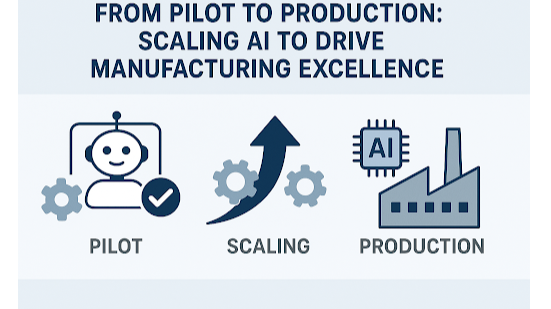
The Manufacturing AI Paradox: High Adoption, Low Scalability
The manufacturing sector is in the midst of an unprecedented technological transformation, driven by the promise of Artificial Intelligence (AI). Investment is surging, and adoption is widespread. Recent industry surveys reveal that over 77% of manufacturers have now integrated some form of AI into their operations, a notable increase from 70% in 2023. This momentum shows no signs of slowing, with a remarkable 82% of manufacturing leaders planning to increase their AI budgets in the coming year. The market forecasts reflect this aggressive adoption, projecting a CAGR of 46.5% from 2025 to 2030, signaling a multi-billion dollar rush to create smarter, more agile factories.
However, beneath this surface of enthusiastic investment lies a troubling paradox. Despite the high rate of adoption, a vast majority of these initiatives fail to deliver on their transformative potential. An estimated 70% of manufacturing companies find themselves trapped in "pilot mode”. This challenge reflects a broader pattern explored in The AI Leadership Paradox: Why 92% of Companies Are Increasing AI Investment, But Only 1% Achieve True Integration, which examines why despite massive investments, true AI integration remains elusive for most organizations.
Manufacturing organizations struggle with being unable to scale successful proofs of concept beyond a single production line or a limited use case. This widespread phenomenon, aptly termed "pilot purgatory," represents more than just a frustrating bottleneck; it is a significant strategic risk, consuming millions in resources for projects that yield only localized, fleeting results. This chasm between ambition and reality is further deepened by a critical workforce readiness crisis. While 95% of manufacturing organizations report using AI, a staggering 71% of their leaders concede that their workforce is not adequately prepared to leverage it effectively. This disconnect between technological deployment and human capability is a clear indicator that the primary obstacles to scaling AI are not technical, but profoundly strategic and organizational.
Moving Beyond Experimentation to Enterprise-Wide Transformation
The central argument of this article is that escaping pilot purgatory and unlocking the full value of AI requires a fundamental shift in mindset. The challenge is not about running more models or launching more pilots; it is about fundamentally rewiring how the organization operates, from the C-suite to the shop floor. True AI transformation is not a series of isolated technology projects but a holistic, integrated business strategy. It demands a disciplined approach that begins long before the first algorithm is written and continues long after the first model is deployed.
The path to success has been illuminated by a select group of industry leaders. McKinsey’s Global Lighthouse Network, a community of manufacturers demonstrating leadership in adopting Fourth Industrial Revolution technologies at scale, has proven that these challenges are surmountable. These "Lighthouse" factories are not just experimenting with AI; they are deploying it across their value chains to achieve remarkable, enterprise-wide results. The latest cohort of Lighthouses reports that nearly 60% of their top use cases now rely on AI, leading to outcomes such as a two to three-fold increase in productivity, a 50% improvement in service levels, and a near-total 99% reduction in product defects. Their success provides a clear blueprint for others to follow, demonstrating that with the right strategy, AI can be scaled to deliver a durable competitive advantage.

Article Roadmap: A Strategic Framework for Scaling AI
This article provides a comprehensive, step-by-step framework for manufacturing leaders to navigate the complex journey from a promising AI pilot to full-scale production. It is designed to be a strategic guide that moves beyond the hype to offer actionable, data-driven recommendations grounded in the operational realities of the modern factory. We will deconstruct the essential pillars of a successful AI scaling strategy, covering:
- Assessing AI Readiness: How to build a solid foundation by evaluating your organization's strategic, data, technological, and human preparedness.
- Building a Scalable AI Platform: The architectural and operational principles for creating a robust, hybrid platform that supports AI from the cloud to the edge.
- Prioritizing High-Impact Use Cases: How to select and implement initial AI projects that deliver clear, quantifiable ROI and build momentum for broader adoption.
- Overcoming Change Management Challenges: A blueprint for managing the critical human element of transformation, from securing leadership alignment to upskilling the frontline workforceFor a deeper dive into these transformation strategies, see Scaling AI in Operations: Managing Change for Sustainable Impact, which provides practical frameworks for navigating organizational change during AI implementation.
- Measuring and Communicating Business Value: How to establish a comprehensive ROI framework and governance model to track progress, justify investment, and sustain long-term success.
By mastering these five domains, manufacturing leaders can bridge the gap between AI ambition and operational reality, transforming their organizations into more intelligent, agile, and resilient market leaders.
Assessing Manufacturing AI Readiness: Building on a Solid Foundation
The journey to scale AI does not begin with a technology choice; it begins with a rigorous and honest assessment of the organization's fundamental preparedness. The evidence from countless stalled initiatives is clear: AI projects fail not because the algorithms are flawed, but because the organizational ecosystem—the strategy, data, infrastructure, and culture—is not ready to support them at scale. Successful AI scaling is an outcome of deep organizational readiness, and a formal assessment is the first, non-negotiable step to de-risk the investment and create an executable roadmap.
Beyond Technology: A Holistic Readiness Framework
AI readiness is not a simple technical checkbox. It is a composite state reflecting the maturity of a company's strategy, technology, data infrastructure, people, and governance processes, all of which must be aligned to enable the deployment of AI at scale. A formal readiness assessment provides the critical, data-driven baseline needed to map the current state, identify critical gaps, and avoid the expensive false starts that trap so many companies in pilot purgatory.
The process begins with strategy: every proposed AI initiative must be directly mapped to a clear, measurable business Key Performance Indicator (KPI)—such as Overall Equipment Effectiveness (OEE), scrap reduction, or on-time delivery—and must have dedicated executive sponsorship with a defined budget. This strategic alignment ensures that all subsequent technical efforts are grounded in tangible business value.
Furthermore, the assessment must proactively address the primary concerns that manufacturing leaders harbor about AI. The top three concerns are cybersecurity and data privacy (cited by 60% of manufacturers), the high cost of implementation (46%), and employee fears about job displacement and change (42%). A comprehensive readiness framework confronts these issues head-on, ensuring that plans for security, financial governance, and change management are built into the strategy from day one, rather than being treated as afterthoughts.
Evaluating Data Maturity: From Siloed and Reactive to Integrated and Predictive
Data is the lifeblood of any AI system, yet poor data quality, lack of context, and fragmented access are among the most cited reasons for project failure. Manufacturing data is notoriously challenging; it is often described as "messy, fragmented, and operationally unstructured," generated by a multitude of systems that were never designed to share information. Therefore, a critical component of any readiness assessment is to evaluate the organization's position on a data maturity model. This model provides a structured way to understand the journey from basic data awareness to a fully data-driven culture, where data is treated as a strategic asset.
The stages of data maturity can be broadly categorized as follows:
- Low Maturity (Beginner/Awareness): At this initial stage, data practices are often ad-hoc and reactive. Data is trapped in departmental silos with little to no governance, and its quality is unknown. Data literacy across the organization is low, and decisions are still largely based on intuition and experience rather than analytics. The primary focus for companies at this stage is to establish the most basic foundations: implementing critical data quality checks for reporting and creating a business glossary to build a shared understanding of key data terms.
- Intermediate Maturity (Integration/Intelligence): Organizations at this level have begun to recognize the strategic value of their data. They are actively working to break down silos through initial data integration efforts, such as implementing Extract, Transform, Load (ETL) or Extract, Load, Transform (ELT) workflows. Data quality becomes a proactive focus, with investment in tools like data catalogs to improve accessibility, data lineage to track data flows, and Master Data Management (MDM) hubs to create a single source of truth for critical data entities. Data literacy training is often introduced to build capabilities across the business.
- Advanced Maturity (Predictive/Data-Driven Culture): At the highest level of maturity, data is managed as a strategic asset and is deeply embedded in the organization's culture and decision-making processes. Most data management is automated, with self-service tools that empower employees of all technical backgrounds to derive insights. The focus shifts from cleaning data to preventing quality issues at the source by integrating checks at all levels. Data is treated as a product, with clear ownership, robust governance, and automated access controls. This is the stage where an organization is truly ready to support complex, scaled AI applications.
Bridging the Chasm: A Deep Dive into IT/OT Convergence
Nowhere is the challenge of data fragmentation more acute in manufacturing than at the boundary between Information Technology (IT) and Operational Technology (OT). This historical divide represents one of the most significant barriers to scaling AI. The two domains have evolved with fundamentally different priorities, cultures, and technological lifecycles. IT, which manages enterprise systems like ERP and CRM, prioritizes data security, integrity, and confidentiality, operating on relatively short technology refresh cycles of 2-5 years. In contrast, OT, which manages the physical machinery on the factory floor, prioritizes uptime, reliability, and safety above all else, often relying on proprietary systems with lifecycles stretching 20-30 years or more.
This divergence creates a chasm where critical operational data is locked away in isolated, legacy systems, inaccessible to the modern analytics platforms where AI models are built. The solution is not merely technical; it requires a deep strategic and cultural alignment. Successful IT/OT convergence is not about turning plant engineers into data scientists or vice versa; it is a deliberate effort to align people, processes, and technology around a unified data strategy. This is not simply a matter of connecting networks; it is an organizational transformation that requires breaking down long-standing departmental silos and overcoming deeply ingrained cultural differences. The technical challenges of integrating legacy protocols are often solvable; the greater hurdle is fostering the organizational will and collaborative spirit necessary to do so.
Best practices for achieving meaningful IT/OT convergence include:
- Establish a Unified Governance and Strategy: Leadership must champion the convergence initiative, establishing a cross-functional governance team with representation from both IT and OT. This team is responsible for creating a shared vision and defining common KPIs that align the priorities of both groups around business outcomes like efficiency and risk management.
- Foster a Collaborative Culture through Cross-Training: Bridging the cultural gap requires investing in cross-training programs that help IT professionals understand the realities of the plant floor and OT professionals understand the principles of data management and cybersecurity. This shared understanding is the foundation of effective collaboration.
- Implement a Unified Cybersecurity Framework: The convergence of IT and OT expands the cyber-attack surface, making a unified security strategy essential. This involves applying IT security best practices like network segmentation, creating Industrial Demilitarized Zones (IDMZs) to safely buffer OT networks, and establishing a framework to monitor threats across both environments.
- Standardize on Modern Integration Protocols: To break down data silos securely and efficiently, organizations should adopt modern, open standards for industrial communication, such as OPC Unified Architecture (OPC UA) and MQTT. These protocols provide a secure and interoperable way to extract data from OT systems and make it available to IT-level analytics platforms.
The Human Factor: Auditing AI Skill Levels and Identifying Competency Gaps
The final, and perhaps most critical, pillar of AI readiness is the human element. Technology alone delivers no value; it is the people who use it that create results. A lack of internal expertise is cited as a top barrier to AI adoption by 45% of manufacturers. The core challenge is the scarcity of talent possessing the rare blend of deep data science expertise and intimate knowledge of manufacturing processes.
Therefore, a comprehensive readiness assessment must include a formal audit of the organization's existing skills and competencies. This is best accomplished using a structured competency framework that defines the specific knowledge, skills, and behaviors required for various roles in an AI-driven organization. Such a framework moves beyond vague job titles to identify the granular capabilities needed to succeed.
Key competency domains that must be assessed include:
- Communicating with Data & AI: The ability to translate complex analytical outputs into clear business narratives, using data storytelling and visualization to influence decision-making.
- Reading with Data: The foundational skill of critically analyzing data sources, identifying patterns and anomalies, and understanding the context behind the numbers.
- Reasoning with Data & AI: The ability to apply business analysis and statistical methods to formulate hypotheses, design experiments, and draw valid conclusions from data.
- Working with Data & AI: The hands-on technical skills required for data wrangling, predictive modeling, data engineering, and the responsible development and deployment of AI systems.
Conducting this skills audit provides a clear-eyed view of the organization's current capabilities, revealing whether the optimal path forward is to focus on upskilling the existing workforce—the preferred approach for 60% of manufacturers—or to recruit external talent to fill critical gaps. This strategic decision is fundamental to building a workforce that is not just surrounded by technology, but is truly empowered by it.
Building a Robust and Scalable AI Platform for Manufacturing
Once an organization has established its baseline readiness, the focus shifts to building the technological and operational backbone required to support AI at an enterprise scale. Moving from isolated pilots to widespread production demands a fundamental departure from ad-hoc, custom-built solutions. It requires the deliberate construction of a standardized, scalable, and resilient AI platform. This platform is not merely a collection of software tools; it is a new operating model for developing, deploying, and managing AI-powered applications across the entire manufacturing value chain.
Architecting for Scale: A Hybrid Cloud, Edge, and IIoT Reference Model
The first principle of building for scale is to design the architecture for scale from the very beginning. A pilot project cobbled together on a data scientist's laptop may prove a concept, but it will never support a global network of factories. A scalable AI platform must be built on a modern, interoperable architecture that can seamlessly integrate data from diverse sources and deploy intelligence wherever it is needed.
The consensus reference architecture for manufacturing AI is a hybrid edge-cloud architecture. This model recognizes that a one-size-fits-all approach is insufficient for the complex needs of a factory environment.
- The Cloud Layer: The public or private cloud serves as the central hub for the platform. Its virtually unlimited compute and storage capacity make it the ideal environment for computationally intensive tasks like training complex deep learning models on massive datasets. The cloud also provides the centralized services for data governance, model registries, and overall platform management and orchestration.
- The IIoT Layer: This layer consists of the network of connected sensors, cameras, PLCs, and other devices on the factory floor that generate the raw data. The IIoT layer is the sensory system of the smart factory, capturing real-time information about the state of machines, processes, and products.
- The Edge Layer: The edge acts as the critical bridge between the physical world of the factory (IIoT) and the analytical brain in the cloud. Edge devices—ranging from industrial PCs to specialized AI accelerators—are located physically close to the machinery. They perform real-time data processing and, most importantly, run optimized AI models locally for "inference" (making predictions on new data).
This hybrid architecture creates a virtuous cycle: vast amounts of data are collected by IIoT devices, processed and aggregated at the edge, and then sent to the cloud for the heavy-lift of model training. The resulting trained and optimized models are then pushed back out from the cloud to the edge devices, where they can make intelligent decisions in real-time, right next to the production line.
The Role of Edge AI: Enabling Real-Time Decision-Making
For AI to be truly transformative in manufacturing, it cannot remain a distant, analytical function performed in a data center. It must be embedded into the physical processes of the factory, capable of sensing, reasoning, and acting in milliseconds. This is where edge computing becomes indispensable. A cloud-only AI architecture simply cannot meet the "timing-critical realities" of the factory floor due to inherent challenges with latency, connectivity, and cost.
Consider a computer vision system for quality inspection on a high-speed bottling line or an AI model controlling the pressure in an automotive stamping press. In these scenarios, a delay of even a few seconds waiting for a round-trip analysis to the cloud is unacceptable; it could lead to thousands of defective products or a catastrophic line stoppage. Edge AI solves this problem by bringing the intelligence directly to the source of the data and the point of action.
The benefits of an edge-first approach for real-time manufacturing applications are clear:
- Ultra-Low Latency: By performing inference directly on a device located on the assembly line, decisions can be made in milliseconds, enabling real-time process control and quality assurance.
- Operational Autonomy and Resilience: Edge systems can continue to operate even if the connection to the cloud is intermittent or lost entirely, ensuring that critical production processes are not disrupted by network issues.
- Enhanced Security and Compliance: Sensitive operational data, such as proprietary process parameters or images of new product designs, can be processed and stored locally, reducing the risk of data breaches and helping to meet data residency requirements.
- Cost Efficiency: Processing data at the edge significantly reduces the volume of data that needs to be transmitted to and stored in the cloud, leading to substantial savings on bandwidth and storage costs.
Successfully deploying AI at the edge requires specific best practices. This includes designing lightweight, efficient models (e.g., using techniques like quantization or architectures like MobileNet) that can run on resource-constrained edge hardware, building in robust offline operating modes, and utilizing specialized Edge MLOps frameworks to automate the deployment, monitoring, and updating of models across a distributed fleet of devices.
Data as a Product: Implementing a Medallion Architecture
A scalable platform requires a scalable and reliable approach to data management. To move beyond the "messy" data reality of many manufacturers and ensure the high-quality data needed for reliable AI, leading organizations are adopting a structured data processing pattern known as the "medallion architecture." This approach treats data not as a byproduct of operations, but as a managed product, progressively refining it through layers of increasing quality and value.
The architecture consists of three distinct layers:
- Bronze Layer: This is the initial landing zone for all raw data ingested from source systems. Data in the Bronze layer is kept in its original, unaltered format. The primary goal is to capture a complete and historical record of the source data, creating an auditable archive. This layer acts as the raw material for all downstream processing.
- Silver Layer: Data from the Bronze layer is transformed into the Silver layer. Here, the data is cleaned, validated, de-duplicated, and enriched. Heterogeneous data from different OT and IT sources is conformed into standardized, well-defined schemas (e.g., a unified manufacturing data model). The Silver layer represents a reliable, queryable, and enterprise-wide view of the data. It is this "single version of the truth" that serves as the primary source for feeding high-quality, consistent data into AI model training pipelines.
- Gold Layer: The Gold layer contains data that has been further aggregated and transformed to serve specific business analytics and reporting needs. These are project-specific, highly-refined data tables optimized for consumption by BI dashboards or specific applications. For example, a Gold table might contain the pre-calculated OEE for each production line, updated in near real-time, providing a "single source of truth" for business performance monitoring.
This layered approach provides the discipline and structure needed to manage data quality at scale, ensuring that AI models are built on a foundation of trusted, reliable information.
Operationalizing AI: MLOps Best Practices for Manufacturing
The final component of a scalable AI platform is the operational framework for managing the lifecycle of the machine learning models themselves. MLOps (Machine Learning Operations) is a set of practices that applies the principles of DevOps—such as automation, continuous integration, and continuous delivery—to the unique challenges of the ML lifecycle. It provides the discipline needed to move from artisanal, manually-managed models to a reliable, automated, and industrial-scale "AI factory."
Key MLOps practices that are essential for manufacturing environments include:
- Version Control Everything: To ensure full reproducibility and traceability, every artifact in the ML workflow must be versioned. This includes not only the model training code (managed in Git) but also the datasets used for training (using tools like DVC), the model parameters, and the final trained model itself. This rigorous versioning is critical for debugging, auditing, and rolling back to a previous stable state if a new model fails in production.
- Automate the ML Pipeline: The entire ML lifecycle—from data ingestion and validation to model training, evaluation, and deployment—should be automated in a series of interconnected pipelines. This practice is often referred to as CI/CD/CT (Continuous Integration/Continuous Deployment/Continuous Training). A crucial element for manufacturing is Continuous Training (CT), where pipelines are designed to automatically retrain and redeploy models when new data becomes available or when model performance starts to degrade (a phenomenon known as "model drift"). This ensures that models remain accurate as factory conditions, raw materials, or product specifications change over time.
- Monitor Models in Production: A model is not "done" once it is deployed. Continuous monitoring is essential to ensure it is performing as expected and delivering business value. This goes beyond tracking technical system metrics like latency and server load. It requires monitoring the statistical properties of the input data to detect drift, tracking the model's predictive accuracy over time, and, most importantly, measuring its impact on the target business KPIs. Automated alerting systems should be in place to notify the team immediately if performance degrades below a predefined threshold.
- Embrace a Modular and Scalable Architecture: ML pipelines should be designed as a series of modular, independent, and reusable components. This makes the system easier to maintain, debug, and update. Using containerization technologies like Docker and orchestration platforms like Kubernetes is a best practice for packaging these components and ensuring they can be scaled horizontally and deployed consistently across different environments, from the cloud to the edge.
By adopting these MLOps principles, manufacturers can transform their AI initiatives from fragile, one-off projects into a robust, reliable, and scalable operational capability.
Prioritizing Use Cases with Demonstrable High Impact
With a solid foundation of readiness and a scalable platform in place, the next critical step is to translate AI capabilities into tangible business value. The key to building momentum and securing long-term investment is to start with a portfolio of use cases that solve significant operational problems and deliver a clear, compelling, and rapid return on investment.
The most successful AI adopters do not chase technology for its own sake; they meticulously select initial projects that address high-value pain points within their core operations. The analysis of successful deployments across the manufacturing sector reveals three use cases that consistently deliver high impact: predictive maintenance, automated quality inspection, and AI-driven demand forecasting.
Predictive Maintenance: From Theory to Quantifiable ROI
Unplanned equipment downtime is one of the largest sources of lost productivity and revenue in manufacturing. Predictive Maintenance (PdM) directly confronts this challenge by shifting the maintenance paradigm from reactive (fix it when it breaks) or preventative (fix it on a fixed schedule) to predictive (fix it just before it is about to break). By deploying IIoT sensors to collect real-time data on equipment health—such as vibration, temperature, and acoustics—and using AI models to analyze this data, manufacturers can detect the subtle signatures of impending failure days or even weeks in advance.
This foresight allows maintenance to be scheduled proactively, minimizing disruption and maximizing asset utilization. The business case for PdM is not theoretical; it is backed by extensive, quantifiable results from real-world implementations:
- General Motors implemented a PdM system using IoT sensors and AI to monitor its fleet of assembly line robots. The system identified early signs of wear and potential failures, resulting in a 15% reduction in unexpected downtime and annual savings of $20 million in maintenance expenses.
- Ford's commercial vehicle division deployed a PdM solution that saved an estimated 122,000 hours of downtime and $7 million on a single component type by successfully predicting 22% of failures ten days in advance.
- Industry-wide benchmarks confirm these powerful returns. Successful PdM programs can reduce equipment breakdowns by 70-75%, decrease total downtime by 35-45%, and lower overall maintenance costs by 10-40%. The U.S. Department of Energy has documented cases where PdM delivers a potential high ROI.
The most effective strategy for initiating a PdM program is to start with high-impact, "quick-win" assets. Rotating machinery such as pumps, motors, and fans are often ideal candidates, as their failure modes are well-understood and can typically be detected through vibration analysis, providing a clear path to demonstrating value early.

Automated Quality Inspection: Enhancing Precision and Throughput with Computer Vision
Manual visual inspection for quality control is a fundamental but deeply flawed process in many manufacturing operations. It is labor-intensive, subjective, prone to human error and fatigue, and often creates a significant bottleneck that limits production throughput. Computer vision, a field of AI that trains machines to interpret and understand the visual world, offers a powerful solution to automate and elevate this critical process.
By installing high-resolution cameras on the production line and training AI models to "see" defects, manufacturers can inspect 100% of products in real-time with a level of speed, consistency, and precision that is impossible for human inspectors to achieve. These systems can detect a wide range of anomalies, from microscopic cracks and surface blemishes to incorrect assembly and misprinted labels. The value generated by these systems is immediate and substantial:
- A precision parts manufacturer struggling with inconsistent manual inspection implemented a computer vision system. The results were transformative: the defect detection rate soared from 76% to 99.3%, customer returns due to quality issues plummeted by 91%, and quality control labor costs were cut by 64%, all while enabling a shift from 15% sample-based inspection to 100% inspection of all parts.
- In the food and beverage industry, a German bottle cap manufacturer introduced a machine vision system capable of inspecting up to 120 caps per minute. The system checks for flaws in shape, material, and print quality, significantly increasing accuracy and efficiency while reducing the need for manual labor.
- General industry benchmarks suggest that AI-powered quality control can reduce overall manufacturing costs by up to 20%. Well-implemented systems can achieve a confidence level in defect detection of 95-99%, effectively eliminating human error from the inspection process.
The success of a computer vision project hinges on its deep integration into the production workflow. The goal is not simply to generate a report of defects but to create a closed-loop system where the AI's output triggers an immediate action, such as automatically rejecting a faulty part from the conveyor or providing real-time feedback to upstream processes to prevent similar defects from occurring.
Supply Chain Optimization: AI-Driven Demand Forecasting for a Resilient Value Chain
In today's volatile global market, accurate demand forecasting is the bedrock of an efficient and resilient supply chain. Traditional forecasting methods, which rely heavily on historical sales data and simple statistical models, are often too slow and inaccurate to cope with rapid market shifts, promotions, or external disruptions. This inaccuracy leads directly to costly operational inefficiencies, such as stockouts that result in lost sales and frustrated customers, or excess inventory that ties up working capital and increases holding costs.
AI-driven demand forecasting fundamentally changes this equation. Machine learning models can analyze vast and diverse datasets that are far beyond the scope of traditional methods. They can ingest not only historical sales data but also a wide array of external factors, including macroeconomic indicators, social media sentiment, weather patterns, and competitor pricing, to identify complex patterns and generate forecasts with a much higher degree of accuracy and granularity. The impact of this improved accuracy reverberates across the entire supply chain, from procurement and inventory management to production planning and logistics.
The ROI from AI-powered forecasting is well-documented across industries:
- A global food manufacturer, in a case study with C3 AI, implemented an AI forecasting system that ingested data from 18 disparate sources. The solution improved demand forecast accuracy by 8 percentage points, enabled daily forecasting for the first time (a 7x increase in frequency), and increased on-time-in-full (OTIF) delivery by 2 percentage points. At scale, this improvement in service level was projected to unlock approximately $30 million in additional gross margin.
- A multinational healthcare conglomerate, working with Turing, deployed an AI forecasting solution to address chronic inventory imbalances. The system led to a 30% reduction in stockouts, a 25% reduction in overstock situations, and a 15% reduction in overall inventory holding costs.
- Consumer goods giant Procter & Gamble uses AI to generate highly granular demand forecasts at the individual product and store level. This allows the company to optimize inventory and replenishment strategies to avoid stockouts while minimizing carrying costs, even for new product launches with no historical data.
The key to maximizing the value of AI in demand forecasting is to ensure that the model's outputs are deeply integrated with downstream planning systems. A more accurate forecast has limited value if it is not used to automatically inform and optimize inventory policies, production schedules, and material procurement plans.
Overcoming the People Challenge: A Change Management Blueprint for AI
While technology platforms and high-impact use cases are essential components of an AI strategy, they are insufficient on their own. The most sophisticated algorithm will fail if the people who are meant to use it do not trust it, understand it, or feel empowered by it. The human element is consistently the most significant hurdle to scaling AI, and organizational and cultural resistance is a primary cause of failure. Fear of job displacement is rampant, and AI is often perceived as a threat to be resisted rather than a tool to be embraced. Therefore, a deliberate, human-centric change management strategy is not an optional extra; it is the core engine that drives successful adoption and value realization.
Securing Executive Sponsorship and Aligning Leadership
Lasting organizational change must be driven from the top. Successful AI adoption requires a clear, consistent, and unified vision from the executive leadership team. Misalignment at this level—for example, a CEO who favors hiring external talent clashing with a CTO who wants to upskill the current workforce—creates confusion and slows progress to a crawl.
The first step in any change management plan is to make AI a boardroom-level priority. This involves establishing a cross-functional AI steering committee with representation from all key stakeholder groups: business line leaders, IT, OT, finance, HR, and, critically, frontline operational managers. This committee is responsible for creating a shared vision, aligning the AI strategy with overall business objectives, and ensuring that the technology roadmap is inextricably linked to the talent development roadmap.
Leaders must then become passionate, visible advocates for this vision. This requires more than just approving a budget; it involves actively championing the change, transparently addressing employee concerns, and consistently communicating a compelling business case that clearly outlines the goals, potential risks, and calculated ROI of the AI initiatives. This leadership alignment and advocacy are the foundation upon which all other change management activities are built.
Engaging the Frontline: From Resistance and Fear to Advocacy and Adoption
With leadership aligned, the focus must shift to the frontline workforce—the machine operators, maintenance technicians, and quality inspectors whose daily work will be most directly impacted by AI. It is here that resistance is often strongest, fueled by uncertainty and fear. Overcoming this requires a proactive and empathetic engagement strategy that aims to build trust and foster a sense of ownership.
Effective strategies for frontline engagement include:
- Communicate Transparently and Continuously: The communication strategy must be built on a foundation of transparency. Leaders must clearly articulate the "why" behind the change, explaining how AI is intended to support and augment human capabilities—making jobs safer, less tedious, and more impactful—rather than to replace them. This narrative must be consistent and repeated often through multiple channels.
- Involve Employees Early and Often: The surest way to foster a sense of ownership is to involve employees in the process from the very beginning. Instead of having an AI solution imposed upon them, frontline workers should be invited to participate in workshops to identify pain points, co-design new workflows, and provide feedback during pilot programs. This collaborative approach turns them from passive recipients of change into active participants in their own future.
- Identify and Empower Champions: Within any organization, there will be individuals who are naturally enthusiastic about new technology. These individuals should be identified early and cultivated as "AI champions." By providing them with extra training and a platform to share their experiences, they can become powerful and credible advocates for change, inspiring their peers and helping to overcome skepticism in a way that top-down communication cannot.
Ultimately, the goal is to build psychological safety. Employees must trust that the organization is invested in their future and that AI is a tool for their empowerment. Without this trust, even the most technically perfect AI system will be met with passive resistance and low adoption, sabotaging any potential for ROI.

Upskilling the Workforce: Building a Future-Ready Competency Framework
Addressing the skills gap is the most tangible way to demonstrate a commitment to the workforce's future. While 60% of manufacturers identify training as their top approach to closing this gap, the execution often falls short. A recent study found that while 44% of leaders have received AI upskilling, only 14% of frontline workers can say the same—a dangerous disconnect that leaves the majority of the workforce unprepared.
An effective upskilling program must be strategic, scalable, and tailored to the needs of the modern manufacturing environment. This involves:
- Moving Beyond One-Size-Fits-All Training: Generic, lecture-based training is ineffective. Learning must be modular, role-specific, and provide hands-on experience with the new AI tools that employees will be using in their daily jobs. Learning paths should be customized based on the formal competency framework established during the readiness assessment.
- Leveraging Modern Learning Technologies: The training itself can be enhanced by technology. Digital tools like Augmented Reality (AR) and Virtual Reality (VR) can provide immersive, experiential learning environments where workers can practice new, AI-driven processes in a safe and controlled setting before they are deployed on the live production line.
- Developing Both Hard and Soft Skills: The curriculum must focus on more than just technical proficiency. As AI and automation take over more routine, repetitive tasks, uniquely human skills become even more valuable. Training programs must therefore also focus on developing soft skills such as critical thinking, complex problem-solving, adaptability, and collaboration, which are essential for workers to thrive in an AI-augmented workplace.
This investment in upskilling does more than just close a capability gap; it fundamentally redefines the relationship between the worker and the technology. It helps to shift the narrative from one where AI is a threat to their current job, to one where AI is a pathway to a more valuable and relevant future role.
Aligning Incentives: Redefining KPIs to Drive AI-Centric Behaviors
To ensure that behavioral changes are sustained over the long term, they must be reinforced by the organization's formal systems of reward and recognition. If employees are trained on new AI-driven processes but are still measured and compensated based on old, outdated metrics, the change will not stick.
Therefore, the final step in the change management blueprint is to align incentives and performance metrics with the desired AI-centric behaviors. This means tying AI readiness and adoption rates directly to the core business KPIs that the organization values most, such as productivity, quality, yield, uptime, and scrap reduction.
The success of an AI project should not be measured solely by the technical accuracy of its model. Instead, success must be defined by the model's measurable impact on these critical operational KPIs. When teams and individuals are evaluated and rewarded based on the business value they deliver using AI, the technology becomes fully integrated into the operational DNA of the organization, completing the transition from a novel experiment to a core business capability.
Measuring and Communicating AI’s Business Value
The final stage of the AI scaling journey is to close the loop: to rigorously measure the value created by the deployed solutions and to establish the governance and communication mechanisms needed to sustain momentum, justify future investment, and ensure the responsible use of the technology over the long term. Without a disciplined approach to value measurement, AI initiatives risk being perceived as costly science experiments with no clear connection to the bottom line. Transparent, data-driven reporting is what transforms a successful deployment into a strategic asset that builds trust and drives continuous improvement.
A Comprehensive ROI Framework: Beyond Cost Savings
One of the most common mistakes in evaluating AI is focusing too narrowly on direct, short-term cost savings. While efficiency gains are an important part of the value equation, a truly comprehensive Return on Investment (ROI) framework must capture a much broader spectrum of both tangible and intangible benefits that contribute to the overall business case.
A nuanced approach to ROI measurement is required because AI's value is often multifaceted. It is not just a cost-saving tool but a business growth enabler. The framework should therefore track metrics across several categories:
- Tangible Financial Metrics: These are the most direct and quantifiable returns.
- Cost Savings: Reductions in maintenance expenses, inspection labor costs, energy consumption, and scrap rates.
- Productivity and Efficiency Gains: Measurable improvements in labor cost versus output, time saved through the automation of manual tasks, reductions in process cycle times, and increased asset throughput.
- Revenue and Margin Growth: Increased revenue from higher product quality or better on-time delivery, and improved gross margin from reduced stockouts or optimized production schedules.
- Intangible (but Measurable) Strategic Metrics: These benefits are less direct but can have a profound long-term impact on competitiveness.
- Quality and Accuracy: Quantifiable reductions in product defect rates and process error rates.
- Customer Experience: Improvements in customer satisfaction (CSAT) scores and higher on-time-in-full (OTIF) delivery performance.
- Talent and Employee Experience: Positive impacts on employee retention and satisfaction resulting from the automation of tedious, low-value tasks.
- Risk Reduction: The value of preventing costly safety incidents, compliance failures, or major operational disruptions.
It is also crucial for leaders to set realistic expectations regarding the timeline for these returns. While some "quick wins" may show a positive ROI within months, the full, strategic benefits of AI often take 12 to 24 months to become fully measurable as the technology becomes embedded in workflows and the organization adapts. This long-term perspective is essential for avoiding premature disillusionment and maintaining stakeholder commitment. A mature view of AI ROI treats it as a portfolio of investments, balancing short-term, efficiency-focused projects with longer-term, strategic initiatives that build foundational capabilities.

Establishing AI Governance: Ensuring Transparency, Accountability, and Ethical Use
As AI becomes more powerful and more deeply integrated into critical manufacturing processes, a robust governance framework becomes non-negotiable. Effective AI governance is the scaffolding that ensures AI is used responsibly, ethically, and in a way that manages risk and builds trust among employees, customers, and regulators. Far from being a bureaucratic brake on innovation, a strong governance model provides the standardized processes and clear guardrails that actually accelerate the safe and repeatable scaling of new AI applications.
The key pillars of an effective AI governance model for manufacturing include:
- Data Management and Security: This pillar establishes clear policies for data privacy, security, and quality. It includes practices like data encryption, role-based access controls, and regular security audits to protect sensitive operational and business data.
- Transparency and Explainability: This involves making AI processes as understandable as possible. It requires maintaining detailed documentation of the algorithms used, the data sources they are trained on, and the logic behind their decisions. For critical applications, this may involve using "explainable AI" (XAI) techniques to help operators understand why a model made a particular recommendation.
- Accountability and Oversight: This pillar defines clear roles, responsibilities, and lines of accountability for the entire AI lifecycle. It establishes who is responsible for model development, who has the authority to approve a model for production, and who is accountable for its performance and impact once deployed. This often involves the creation of a cross-functional AI governance board or a center of excellence.
- Continuous Monitoring and Risk Management: Governance is not a one-time setup. It requires the continuous monitoring of deployed models to evaluate their performance, check for data and model drift, and audit for potential biases that could lead to unfair or unsafe outcomes. This ensures that AI systems continue to function correctly, ethically, and in compliance with regulations over time.
The Power of Visualization: Using Dashboards and Executive Reviews
To maintain organizational momentum and justify continued investment, the value generated by AI must be made visible and communicated effectively to all stakeholders. This requires translating the complex metrics from the ROI framework into clear, intuitive, and accessible formats.
The most effective way to achieve this is through the implementation of real-time performance dashboards. These dashboards serve as the single source of truth, tracking the agreed-upon KPIs—from OEE and scrap rates on the factory floor to forecast accuracy and inventory turns in the supply chain. They provide operational teams with the immediate feedback they need to optimize processes and give leadership a clear, at-a-glance view of the business impact of their AI investments.
This continuous flow of performance data should feed into a regular cadence of executive reviews. These forums are essential for communicating progress, celebrating wins, analyzing challenges, and making data-driven decisions about where to scale successful solutions and how to allocate resources for future initiatives. This transparent, closed-loop process of measuring, visualizing, and reviewing performance is what builds credibility, sustains long-term executive support, and ensures that the AI strategy remains tightly aligned with the strategic objectives of the business.
Conclusion
Synthesizing the Journey: From a Foundational Assessment to Scaled Value
The path from a promising AI pilot to an enterprise-wide engine of manufacturing excellence is a holistic journey, not a simple technology implementation.
It begins with a rigorous, introspective assessment of organizational readiness—a deep evaluation of the strategic, data, infrastructural, and human foundations upon which success must be built. It proceeds through the disciplined construction of a scalable, hybrid AI platform that marries the power of the cloud with the real-time responsiveness of the edge.
This platform becomes the launchpad for high-impact use cases, carefully selected to solve critical business problems and deliver measurable value. However, the technology alone is inert. Its potential is only unlocked through a deliberate, human-centric change management strategy that builds trust, upskills the workforce, and aligns the entire organization around a new, more intelligent way of working. Finally, the journey comes full circle with a robust framework for measuring and communicating the business value created, providing the governance and visibility needed to sustain momentum and drive continuous improvement.
The evidence from both successes and failures is unequivocal: escaping "pilot purgatory" requires a profound shift from a technology-first mindset to a business-value-first strategy. The organizations that succeed are not those with the most sophisticated algorithms, but those with the clearest strategic vision, the most disciplined operational execution, and the deepest commitment to empowering their people through change.
The Competitive Imperative: Why Mastering AI at Scale Defines the Next Generation of Manufacturing Leaders
The manufacturing industry is at a critical inflection point. The widening gap between AI ambition and operational reality is creating a dangerous divergence in competitiveness. On one side are the organizations that remain trapped in the pilot phase, spending valuable resources on isolated experiments that fail to deliver enterprise value. On the other side are the leaders who have cracked the scalability code. These companies are reaping compounding benefits, leveraging AI to drive step-change improvements in quality, efficiency, resilience, and innovation that are fundamentally reshaping their cost structures and competitive positions.
The window for action is rapidly closing. As AI capabilities mature, they are quickly transitioning from a source of differentiation to a matter of table stakes. In the near future, the ability to deploy and manage AI at scale will not be a luxury; it will be a prerequisite for survival. The manufacturers that master the complex but achievable journey from pilot to production will not only navigate the challenges of today but will also position themselves to dominate the markets of tomorrow with an unmatched level of agility, intelligence, and operational excellence. The next generation of manufacturing leaders will be defined by their ability to transform this technological promise into tangible, scaled, and sustainable business value.
Take the Next Step with Alpha Technical Solutions
Are you ready to transform your manufacturing operations with scaled AI? Don't get stuck in "pilot purgatory." At Alpha Technical Solutions, we specialize in guiding manufacturing leaders through every stage of the AI journey, from foundational readiness assessments to the deployment of enterprise-wide solutions.
Visit Alpha Technical Solutions today to learn how our expertise can unlock the full potential of AI for your business. Book a free AI strategy discussion with our experts to assess your unique needs and chart a clear path to manufacturing excellence.