
The Visibility Cliff Behind Every Sourcing Decision

The most consequential supplier in your network is probably one you have never met. McKinsey's 2025 supply chain risk survey found that the majority of companies still understand their supply chain only up to tier one, while 85% of disruptions originate at tier two or below. A Deloitte CPO survey put the gap in even starker terms: only 15% of chief procurement officers have visibility beyond their direct suppliers. The disruptions, when they hit, are not cheap — extended supply chain shocks now occur roughly every 3.7 years and can erase up to 45% of a year's profit over a decade.
Traditional sourcing scorecards were not built for this. They reduce a supplier to a row in a spreadsheet — a price, a lead time, a quality grade — and ask a buyer to make tradeoffs in isolation. That model worked when supply chains were short and signals arrived through annual audits. It does not work when the same chain is being squeezed by tariffs, due-diligence regulations, climate disruption, and customer expectations all at once. In the same McKinsey survey, 82% of companies reported that their supply chains are affected by new tariffs alone.
What is replacing the scorecard is something more structural: the supplier graph. A supplier graph is a knowledge graph that models suppliers, components, sites, contracts, and the dependencies between them as a connected network rather than a flat list. Layered on top, three live signal streams — ESG, telemetry, and escape rates — turn that graph into a working substrate for resilient sourcing decisions. This article unpacks why that substrate matters, what those three signals look like in practice, and how to operationalize the output without falling into the "AI replaces the buyer" trap. Reaching that maturity requires the kind of data foundation that most organizations are still in the middle of building.
Why Supplier Graphs Replace Sourcing Scorecards

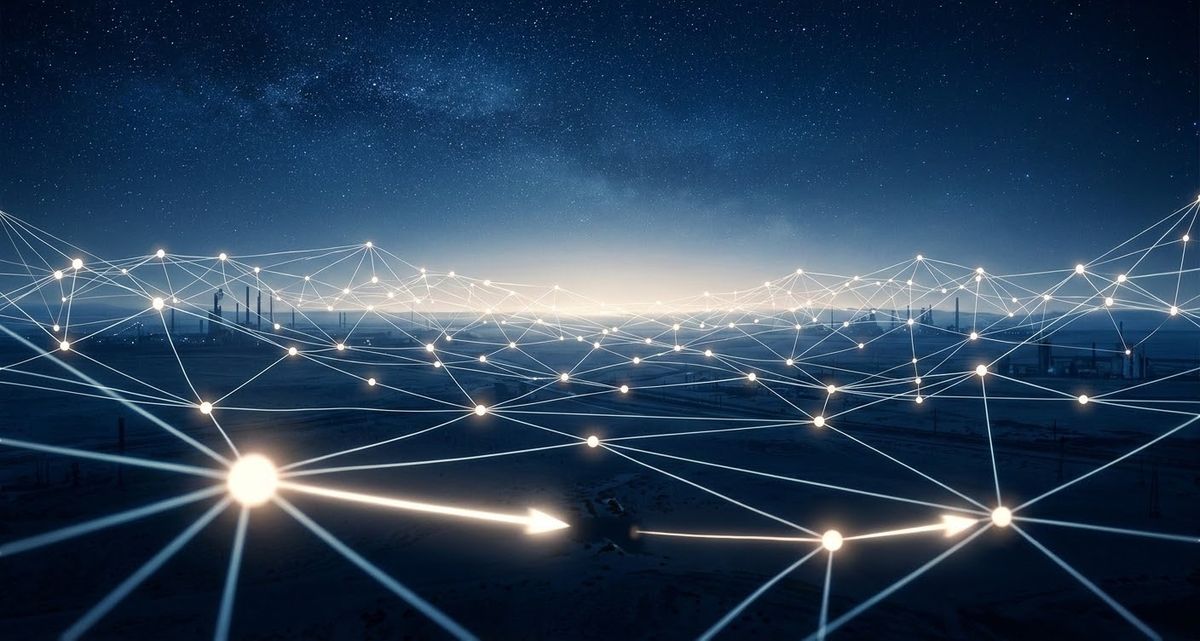
A supplier graph is less a database than a map of a real-world network. Nodes are suppliers, sites, components, and contracts; edges are the relationships between them — who supplies whom, which factory produces which SKU, which contract governs which shipment. Researchers have shown that posing supply chain visibility as a link prediction problem on a knowledge graph allows graph neural networks to surface dependencies that the buyer never explicitly recorded.
The advantage over scorecards is structural. A scorecard tells you a tier-one supplier is rated A. A graph tells you that same supplier draws 70% of a critical alloy from a single tier-three foundry in a sanctioned region — the exact kind of dependency that classical procurement systems hide. Hitachi and others have published case studies demonstrating that GNN-based reasoning over multi-tier supplier networks predicts disruptions that flat KPIs miss entirely. Recent work on GraphRAG architectures combines vector search with graph context, so a procurement team can ask "what is exposed if Port of Ningbo closes for two weeks" and get an answer grounded in the actual network topology rather than a generic LLM hallucination.
The graph is also how you escape the limits of contractual visibility. Most companies have contracts only with tier one, which means tier two and three data has to be inferred — from public filings, customs records, ESG disclosures, and pattern recognition across the buyer's wider portfolio. The graph is the only data structure that holds those inferences without forcing them into a flat schema, and building it requires the same discipline of breaking down data silos that defines every serious AI-in-operations program.
The Three Signal Streams That Make a Graph Useful

A graph by itself is just topology. What gives it predictive value is the live signal streams attached to each node. Three streams matter most.
ESG signals. Regulatory pressure has turned ESG from a reporting exercise into an operational input. The EU Corporate Sustainability Due Diligence Directive obligates large companies to identify and remediate human rights and environmental harms across their value chains, with penalties up to 5% of annual turnover for non-compliance. AI-driven supplier risk platforms now ingest a buyer's vendor list and pull live signals — financial filings, regulatory databases, sanctions lists, adverse-media coverage, ESG disclosures — to score each node continuously. Vendors like Worldfavor and IntegrityNext document use cases where a single negative ESG signal on a tier-three supplier triggers a re-routing decision before a regulator notices. This is no longer a CSR exercise; it is a live procurement input.
Telemetry signals. Telemetry is the IoT layer of supplier risk — sensor data from production lines, shipments, and warehouses that captures the operational health of a supplier in real time. Samsara, one of the largest providers, processes more than 25 trillion data points a year across vehicle telematics, equipment monitoring, and safety systems. For a procurement team, telemetry surfaces the early warning signs that lagging KPIs miss: rising machine downtime at a tier-two plant, drift in cold-chain temperature for a critical biologic, repeated quality-test failures that have not yet escalated into a formal complaint. The same instrumentation logic that powers AI-driven predictive maintenance inside the four walls of a plant turns the supplier graph from a static map into a living dashboard when extended outward.
Escape rates. Escape rate is a quality metric — the share of defects that reach the customer rather than being caught upstream. Six Sigma frames it cleanly: Level 6 quality is 3.4 defects per million, Level 4 is 6,210, and modern manufacturing benchmarks for incoming materials sit around 75 parts per million. A good defect escape rate is typically below 5%. The signal matters because supplier-attributed defects compound asymmetrically downstream. In automotive, suppliers' share of recall costs reached 15 to 20% by 2018, and supplier-named recall notices doubled in the prior five years. Tracking escape rate per supplier per component over time, on the same graph, exposes which nodes are quietly bleeding quality into your finished goods — a discipline closely related to the broader AI transformation of quality control.
Cost Asymmetry and the Co-pilot Decision Model
Bringing three signal streams together creates a new problem: too many alerts. This is where the framing of AI as a decision co-pilot rather than an autonomous decider earns its keep.
The economics of supplier risk are deeply asymmetric. The cost of a missed failure — a defective component reaching a customer, a forced-labor exposure surfaced by a regulator, an unplanned line stop — is often fifty times higher than the cost of a false alarm that results in a re-inspection or a precautionary re-order. That asymmetry should drive the threshold logic. A model that is calibrated to minimize false negatives, and that surfaces uncertain cases for human review, is the right design. A model tuned to maximize precision at the expense of recall is the wrong design, because it optimizes for the cheap mistake at the expense of the expensive one. This is the same principle that makes tool-wear digital twins useful only when uncertainty is priced explicitly.
The discipline this requires is human-in-the-loop validation. The supplier graph and its three signal streams produce ranked, contextualized recommendations — "this tier-two supplier has a rising ESG flag, declining telemetry, and a 3-month upward trend in escape rate; consider dual-sourcing." A buyer with category expertise then validates the recommendation, adds the human context the model lacks, and either acts or overrides. Gartner has flagged that gen-AI in procurement entered the trough of disillusionment because too many implementations skipped this step and tried to automate the buyer out of the loop. The deployments that survive that trough are the ones built around evidence-based decisions, mistake-proofed by the kind of digital poka-yoke patterns that keep the human accountable rather than a black box recommending action.
From Static Audits to Living Networks

Sourcing is no longer an annual exercise of negotiation and audit. It is a continuous decision under uncertainty about a network that is changing faster than any single team can monitor. Supplier graphs, fed by ESG, telemetry, and escape-rate streams, are how that decision becomes operational.
The honest constraint is data readiness. Gartner reports that 74% of procurement leaders say their data is not AI-ready — meaning supplier records are inconsistent, contracts are unstructured, and tier-N relationships are inferred rather than known. Building the graph is, in practice, the same project as building the data foundation. The companies that will pull ahead in the next sourcing cycle are not the ones with the flashiest model; they are the ones that have done the unglamorous work of stitching their supplier records, IoT feeds, and quality data into a single connected substrate, then layered governance on top so that the model's recommendations are auditable and the buyer remains accountable.
The promise of resilient sourcing is not that AI will eliminate disruption. Disruption every 3.7 years is the new baseline, and tariffs, climate, and regulation will keep that interval short. The promise is that when disruption hits, the buyer with a living supplier graph will see it sooner, route around it faster, and absorb less of the 45%-of-profit downside that defines the current category.
If your organization is ready to move from static supplier scorecards to a living, AI-augmented sourcing capability, ATS helps industrial teams build the data foundation, graph substrate, and human-in-the-loop governance that make resilient sourcing operational. We work with leadership teams to scope the supplier graph, integrate ESG, telemetry, and quality signals, and design the co-pilot workflows that keep buyers accountable while extending their reach into every tier of the network.