
The Most Expensive Mistake in Industrial AI Right Now

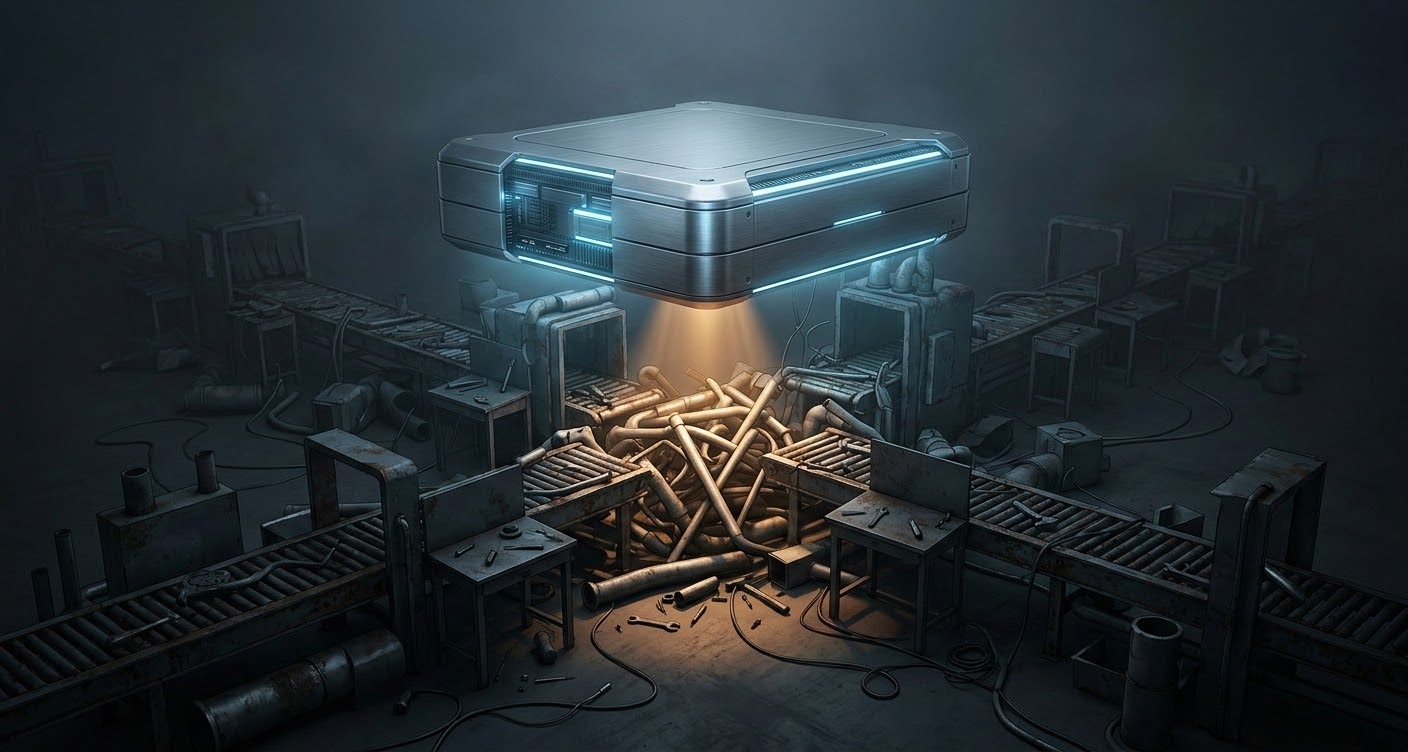
The dominant failure mode of industrial AI in 2025 is not a bad model. It is a model that was successfully deployed on top of a process that should have been deleted. S&P Global Market Intelligence reported this year that the share of companies abandoning most of their AI initiatives jumped from 17% in 2024 to 42% in 2025, and McKinsey's 2025 State of AI survey found that only 21% of organizations using generative AI have redesigned even a single workflow before deploying it. Those are not statistics about model quality. They are statistics about sequencing.
Bill Gates put the principle on a postcard three decades before the LLM era. Automation applied to an efficient operation magnifies efficiency; automation applied to an inefficient operation magnifies the inefficiency. The hard part is admitting that most operations in scope for an AI pilot today are still in the second category — a series of handoffs, manual reconciliations, and tolerated workarounds that no one has redesigned in a decade. The shiny model is being asked to compensate for a process that was never lean to begin with.
This article makes the case that the most valuable thing an industrial AI program can do in its first 90 days is not pick a model. It is run a value-stream diagnostic on the target workflow, eliminate or simplify every non-value-added step it can, and only then ask which of the remaining steps deserve a model. The companies that follow that sequence are the ones that close the gap between AI pilots and AI production.
What Toyota Already Knew About Automation
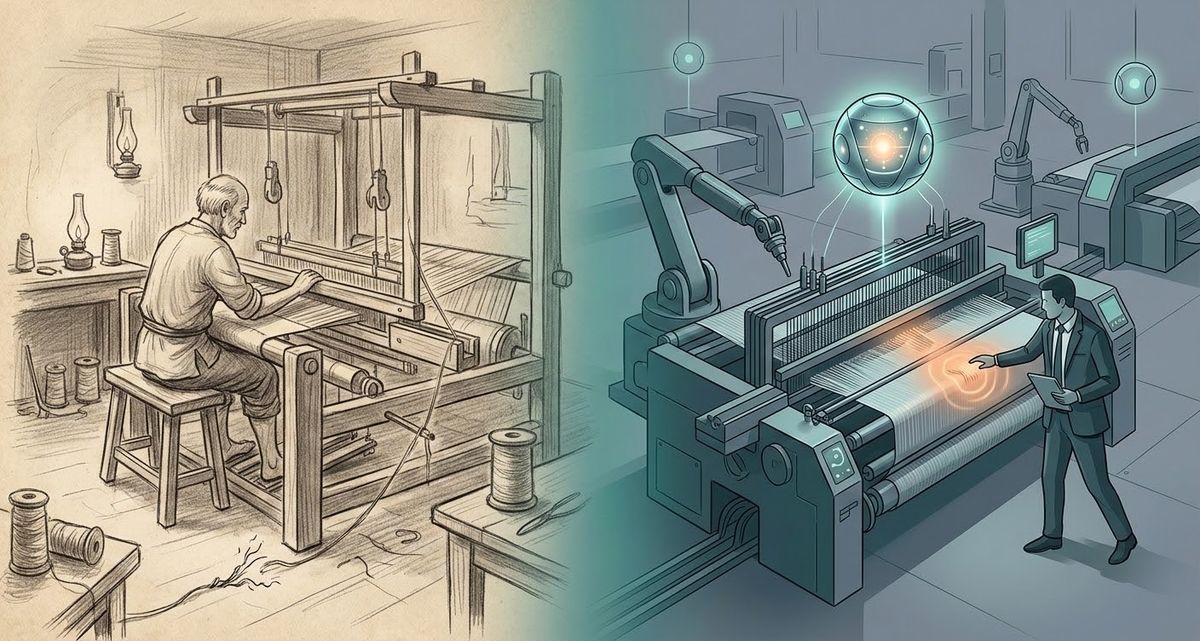
The lean lineage is unambiguous on this question. Taiichi Ohno, the engineer who codified the Toyota Production System, was explicit that you do not start by buying a machine. You do the work thoroughly by hand first, implement kaizen, eliminate muda, mura, and muri, and only then introduce automation. Sakichi Toyoda's original 1896 loom — the ancestor of every modern industrial automation system — was not designed to remove the operator. It was designed to stop itself when a thread broke so the operator could see the defect immediately. Toyota calls this discipline jidoka, or "automation with a human touch", and it remains one of the two pillars of TPS alongside just-in-time.
The eight wastes that Ohno and his successors formalized are still the most useful checklist any industrial AI team can run before it builds anything. The DOWNTIME acronym — Defects, Overproduction, Waiting, Non-utilized talent, Transportation, Inventory, Motion, Extra-processing — describes every category of activity that an AI pilot is likely to make faster without making better. Faster overproduction is still overproduction. Faster waiting is still waiting. A model that automates the generation of a report no one reads has done nothing for the P&L, no matter how sophisticated the model is.
The point is not that lean and AI are at odds. The point is that lean was always the prior step. Researchers studying AI-aided lean manufacturing consistently find that the digital tools deliver outsized returns only when they are layered on standardized, waste-eliminated production systems. Skip the lean step and you are not automating — you are encoding.
What the 2025 Evidence Actually Says

The evidence has caught up to the principle. The single strongest finding in the same McKinsey survey is that fundamental workflow redesign has the highest correlation with EBIT impact of any organizational lever they tested. High performers are nearly three times more likely than their peers to have redesigned at least some workflows. The 21% redesign figure cited in the opening is the inverse of that — nearly 80% of gen-AI users are layering models on top of unchanged processes, exactly the behavior the lean tradition warned against.
BCG's Build for the Future 2025 study reaches the same conclusion from a different angle. The widening gap between AI leaders and laggards is not explained by which models they use. It is explained by whether they redefined roles, decision rights, and workflows — removing unnecessary work — before they digitized anything. The leaders see roughly twice the revenue increase and 40% greater cost reductions from their AI investments.
The World Economic Forum, summarizing the same year of evidence, identified the most common reason AI initiatives fail as the absence of streamlined processes underneath them. A Kaizen Institute poll referenced in the WEF analysis found that 55% of companies cite outdated systems and processes as their biggest barrier to AI implementation. The barrier, in other words, is not the model. It is what the model is being pointed at.
The discipline of eliminating waste before applying technology is also what made our analysis of supplier graphs work in the procurement category: before a graph can give a buyer signal, the duplicate vendor records, unreconciled contracts, and orphaned SKUs have to be cleaned up. The same logic applies on the factory floor. Before a defect-detection model can earn its keep, the inspection workflow itself has to be examined for steps that should not exist.
A Sequencing Discipline for Manufacturing Operations
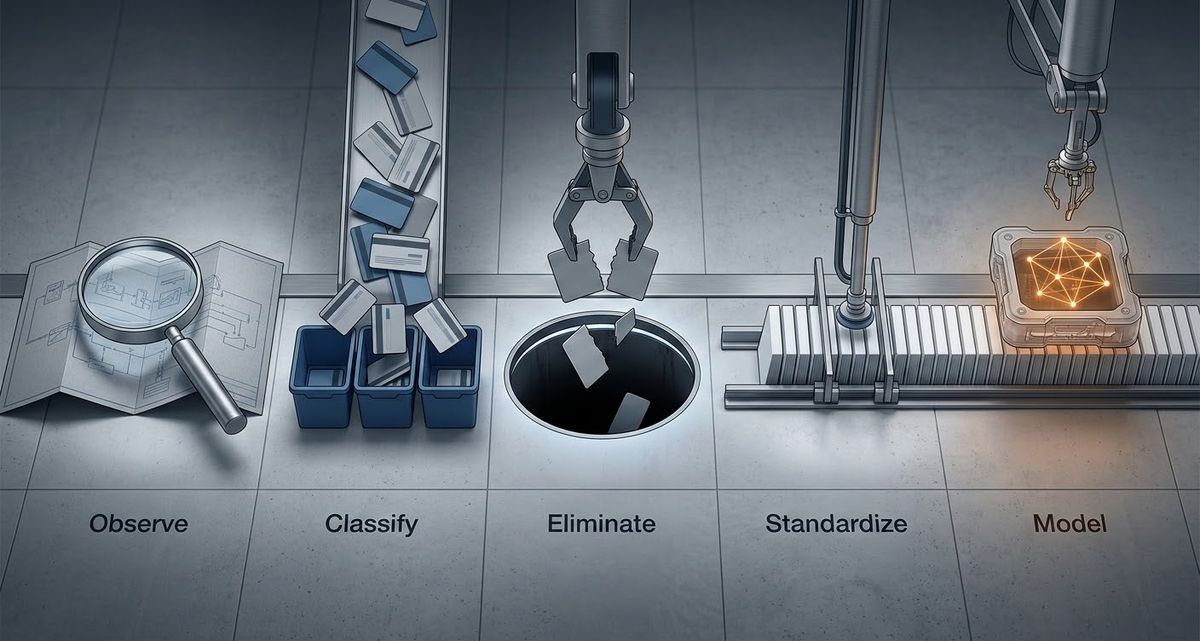
The practical version of "lean before AI" is a five-step sequence that every industrial AI team can run before it commissions a single model. It is recognizable to anyone trained in value stream mapping, but the destination is a model decision rather than a process redesign for its own sake.
Step 1 — Map the current state. Walk the process. Document every step, queue, handoff, and rework loop in the target workflow as it exists today, not as the SOP claims it should be. Capture cycle time, wait time, and the defect rate at each step. The goal is a current-state map honest enough that everyone in the room recognizes their own work.
Step 2 — Classify each step by value. Mark each step as value-adding, business-non-value-adding (required for compliance or accounting but not for the customer), or pure waste. In a typical manufacturing workflow, somewhere between 40% and 70% of steps land in the second or third bucket. Those are the candidates for elimination, not automation.
Step 3 — Eliminate before you automate. Delete the pure-waste steps outright. Simplify or merge the business-non-value-added steps where possible. This is the most uncomfortable and the most valuable part of the sequence. It is also where AI programs most commonly skip ahead — because elimination is a political conversation and modeling is a procurement conversation.
Step 4 — Standardize the remaining work. Apply the second pillar of TPS — jidoka — by designing each remaining step so that abnormalities surface immediately and a human can intervene. Standard work is the substrate that any AI model will need to learn from. A process that varies operator-to-operator and shift-to-shift cannot be modeled reliably; it can only be averaged.
Step 5 — Now decide what to model. Of the remaining standardized steps, ask which ones are bottlenecked by a pattern-recognition problem that exceeds human throughput or consistency. Defect detection at scale, predictive maintenance, scheduling under high combinatorial complexity, and quality root-cause analysis are the canonical wins. A model trained on a clean, simplified workflow with standardized inputs is a fundamentally different proposition from a model trained on whatever data the legacy system happened to log.
Manufacturers who run this sequence consistently report that the model they end up deploying is smaller, cheaper, and more reliable than the one they would have built without it. The published BMW analysis is a useful reference point — once the inspection process itself was standardized, a defect-detection model delivered a 30% improvement in detection rates, a 25% reduction in inspection time, and a 15% decrease in rework costs. The model is the visible part. The standardization is what made the model work.
The Cost of Skipping the Lean Step
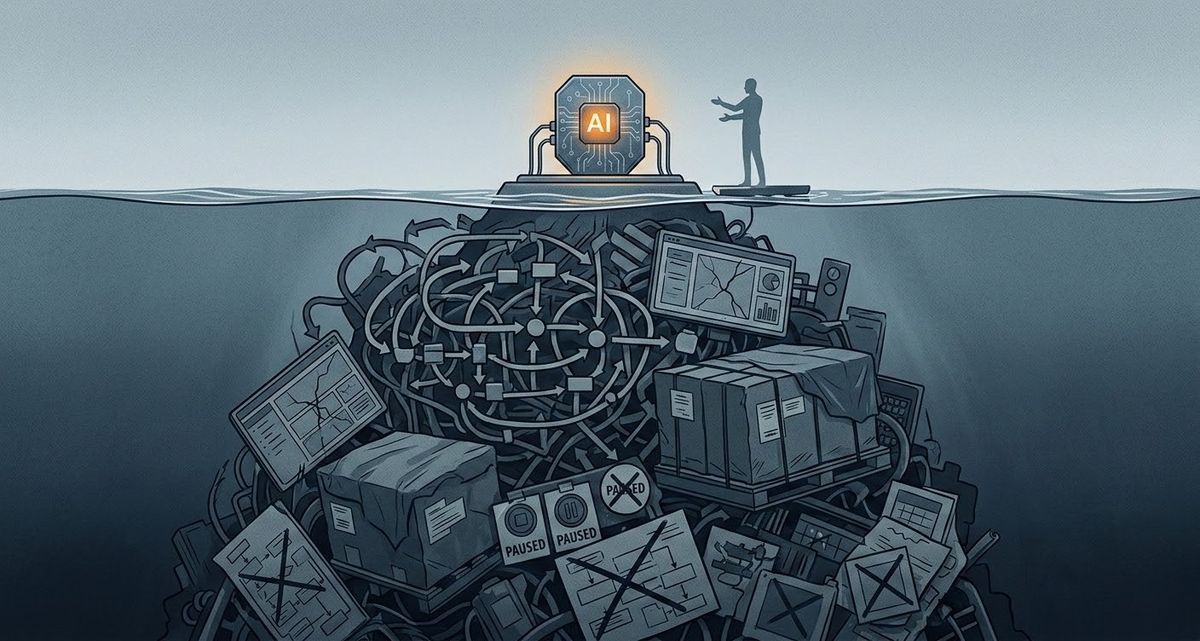
The hidden cost of automating waste is almost always larger than the visible cost of the AI program itself. Cost of Poor Quality in mid-market manufacturing now sits at 15–25% of annual revenue — scrap, rework, warranty claims, and customer churn that a non-lean operation absorbs as the cost of doing business. Layer an AI program on top of that without eliminating the underlying waste, and you compound three problems at once: you pay for the model, you pay for the integration, and you pay for the institutional commitment to a process that the model has now made harder to remove.
There is a second cost that is harder to quantify but more corrosive: the credibility cost. Every AI pilot that gets deployed on top of a bad process and fails to move a KPI makes the next AI pilot harder to fund. The 42% abandonment figure in the S&P Global survey is not just a statistic about wasted budget. It is a statistic about organizations losing the political license to keep investing in AI at all. The companies that protect that license are the ones who can show that their AI dollars went to genuinely re-engineered workflows, not to encoded historical waste.
The same governance discipline we argued for in last week's piece on supplier graphs — human-in-the-loop validation, cost-asymmetric thresholds, auditable decisions — is the right governance discipline here too. The model is not the agent of change. The model is the artifact left behind after the change has happened.
The Working Definition of an AI-Ready Process
An AI-ready process is not a process that has been instrumented with sensors. It is a process that has been examined and pruned. It is a process where the steps that remain are the steps that genuinely add value. It is a process where the standard work is documented well enough that a model can learn from it, and where a human is positioned at the right point to intervene when the model is wrong. It is a process, in other words, that a lean practitioner would have recognized as healthy ten years before the term "generative AI" was in use.
The companies pulling ahead in industrial AI are not the ones with the largest model budgets. They are the ones who have done the unglamorous work of removing steps, standardizing the remaining ones, and putting humans where the cost asymmetry says humans should be. The technology has changed. The sequencing has not.
If your organization is weighing where to point its next industrial AI investment, the most useful diagnostic is rarely "which model do we pick." It is "which steps in this workflow would we delete if we were starting from scratch — and what would the model look like on the workflow that remains." ATS helps industrial teams run that diagnostic, redesign the workflow against lean principles, and design the human-in-the-loop governance that keeps the resulting model accountable. The waste-first sequence is what turns an AI pilot into an AI program.