

1. Introduction: The Strategic Pivot from Administration to Cognitive Engineering
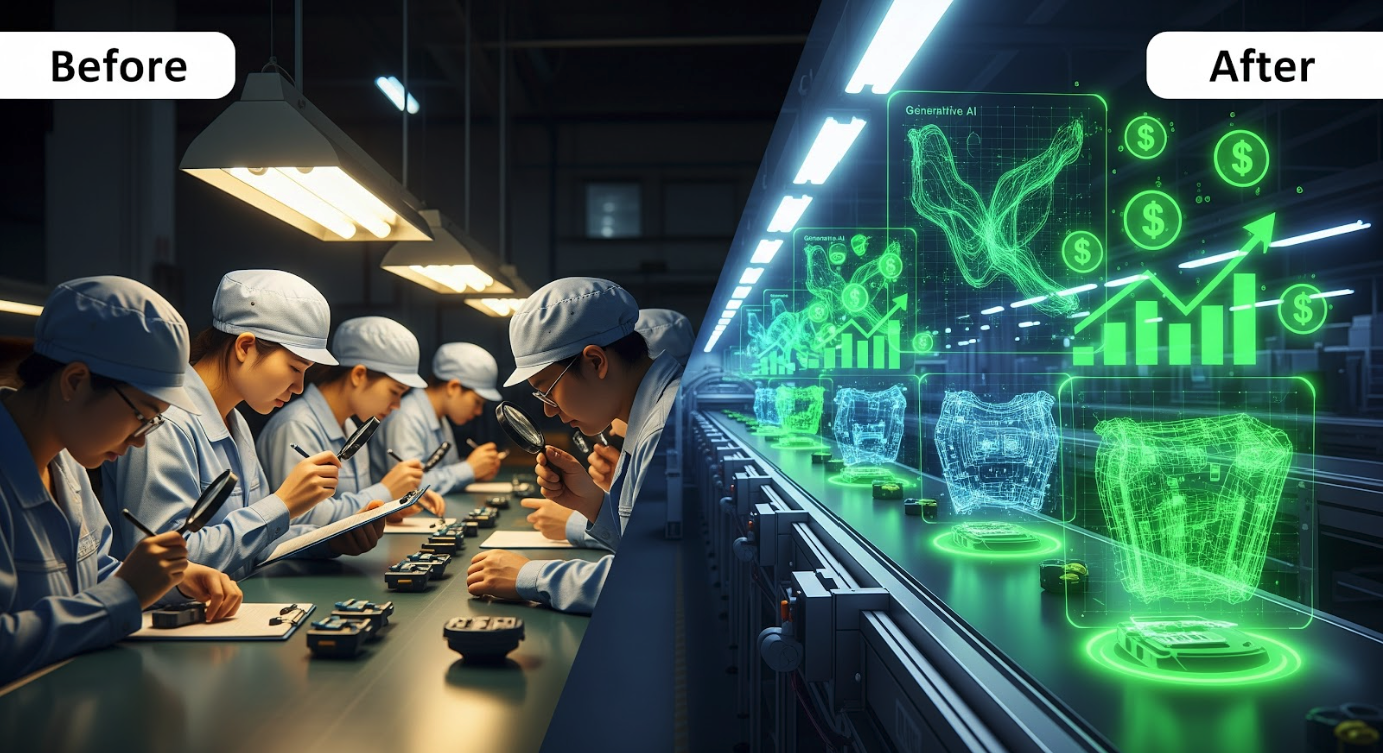
The global manufacturing sector stands at the precipice of a structural transformation that is redefining the competitive landscape of precision engineering and contract manufacturing. For decades, the pre-sales process—specifically quoting and estimating—has been viewed as a necessary administrative burden. It has been treated as a cost center, a gatekeeping function populated by seasoned experts navigating complex spreadsheets and relying on intuition honed over years of trial and error. However, this traditional model is collapsing under the weight of modern market demands. The velocity of commerce has accelerated, product lifecycles have shortened, and the geometric complexity of designs has increased exponentially. In this environment, the legacy approach to quoting is no longer merely inefficient; it represents an existential risk.
A profound shift is underway, moving the industry from manual administration to AI-driven pre-sales engineering. This transition is not merely about digitizing paper processes; it represents the digitization of manufacturing expertise itself. Artificial Intelligence (AI) is evolving into a AI Sales Engineer for Manufacturing, capable of performing complex geometric analyses, predicting cycle times with physics-based precision, and assessing financial risk in seconds. This marks the dawn of "computational estimating," where every quote is a data-driven simulation of the manufacturing process rather than a rough approximation based on tribal knowledge.
The urgency of this transformation is driven by the "Velocity Trap." Manufacturers are caught between the need for speed—where 78% of customers buy from the first responder—and the need for accuracy, where a single missed feature can destroy the margin of an entire job. In the analog world, this was a zero-sum game: be fast and risky, or slow and accurate.
The AI paradigm shatters this trade-off, offering the capability to be both instant and precise. By embedding manufacturing intelligence into the quoting phase, companies move the "production" timeline to the moment of inquiry, transforming quoting from a passive gatekeeper into a strategic engine of profitability.
2. The Current Quoting Reality: Tribal Knowledge and Hidden Risks
2.1 The Fragility of the Analog Estimator
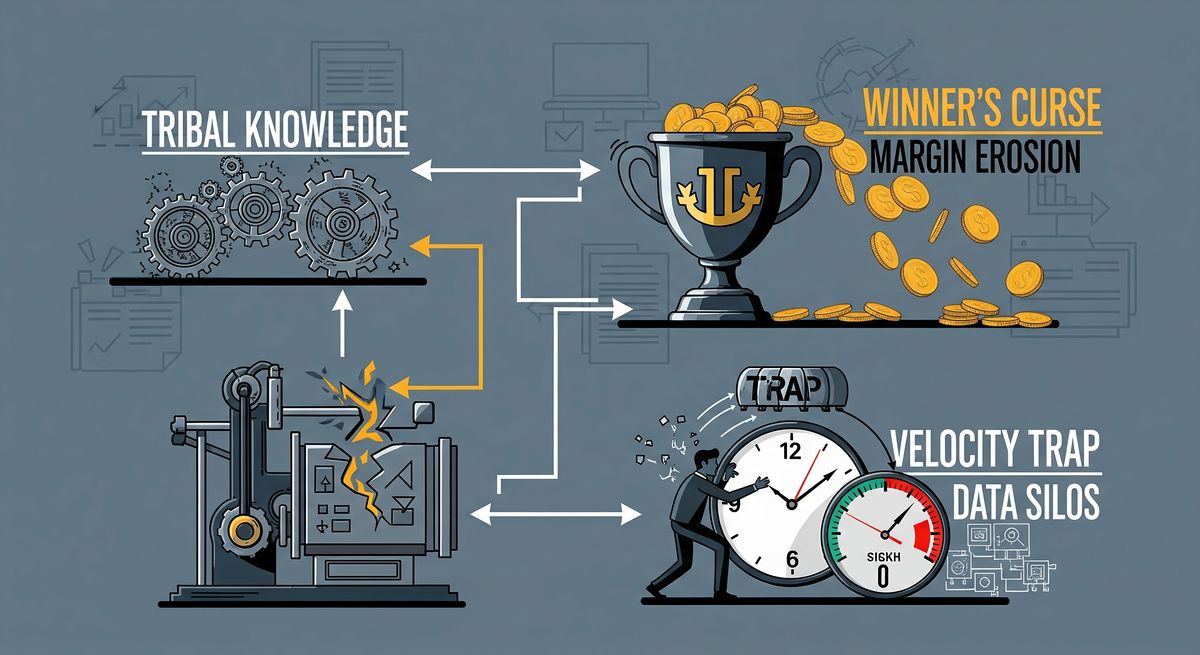
In the current industrial landscape, the estimating department is frequently the primary bottleneck. The process is dangerously reliant on a small cadre of senior experts—often referred to as "tribal elders" or "machinery whisperers"—who possess a deep, uncodified understanding of the shop’s unique capabilities. This reliance on tribal knowledge creates a fragile ecosystem where critical operational intelligence lives in the minds of individuals rather than in the resilient systems of the enterprise.
Tribal knowledge in quoting manifests as intuitive adjustments to cycle times based on "gut feel" or memory-based pricing for complex features. While valuable, this expertise is unscalable. When these experts retire or fall ill, the quoting engine grinds to a halt. This "Brain Drain" is a crisis in manufacturing, where approximately 25% of the workforce is 55 or older. As these veterans leave, they take with them decades of proprietary process knowledge—the "sensory" understanding of how a machine sounds when cutting titanium correctly, or which suppliers can be trusted. Without a system to capture this wisdom, manufacturers face a "strategic bottleneck" where they literally forget how to be profitable.
2.2 The "Winner's Curse" and Margin Erosion
The manual quoting process is inherently prone to the "Winner's Curse," an economic distortion where the winner of a contract is often the supplier who most severely underestimated the costs. Without data-driven simulations, manufacturers frequently underquote complex jobs to win business, only to discover later that actual production costs erode the entire margin.
This margin erosion is often invisible until the job hits the shop floor. A deal closed at a projected 25% margin can plummet to 15% after design changes and sink further to a loss once overhead and rework are factored in. The root cause is the reliance on historical averages rather than physics-based simulation. Manual estimators, under immense pressure for speed, often rely on "guesstimates," exposing the shop to financial risk. This lack of pricing discipline is often a symptom of the estimator's lack of confidence; without a hard, data-backed simulation of cost, they are unable to defend their price against customer pressure, leading to price erosion.
2.3 The Velocity Trap and Data Silos
Modern procurement teams demand speed above all else. Research shows that responding within 5 minutes increases the likelihood of qualifying a lead by 100 times. However, manual estimators face a "Velocity Trap": to respond quickly, they must use rough figures that risk profit; to be accurate, they must delay response and risk losing the revenue. Furthermore, this process is unscalable; human estimators have finite bandwidth, forcing shops to "no-quote" potentially lucrative work during volume surges.
Compounding this is the "Data Disconnect." Critical quoting data is siloed across CAD files (Engineering), ERP systems (Finance), and MES logs (Operations). The manual estimator must bridge these islands, a workflow rife with transcription errors. A missed tolerance or an outdated material cost can result in catastrophic errors. Crucially, the logic used to arrive at a price is rarely captured, preventing the organization from analyzing win/loss trends or learning from past mistakes.
3. AI as the New Pre-Sales Engineer: Geometric Intelligence and Physics-Based Simulation
3.1 Geometric Analysis: The "Vision" of the Digital Engineer
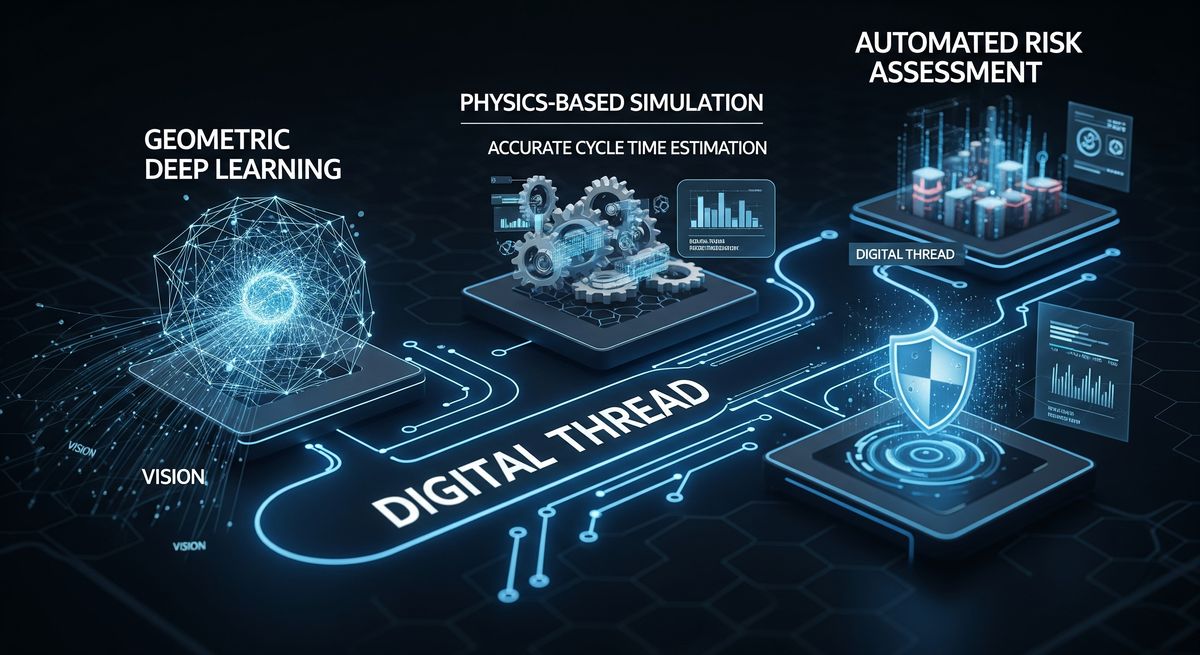
The core capability of the AI pre-sales engineer is its ability to "see" and understand 3D geometry with a depth that surpasses human capability. This involves the mathematical decomposition of the object through Automated Feature Recognition (AFR) and Geometric Deep Learning (GDL).
Boundary Representation (B-Rep) Analysis:
AI algorithms parse the Boundary Representation (B-Rep) of a CAD model, analyzing the topological relationships between vertices, edges, and faces. The system identifies a cylindrical void as a "hole" and, by checking attributes like depth ratios and color codes, classifies it as a "tapped hole" or "counterbore." It instantly maps these features to necessary machining operations, distinguishing between pockets and slots in milliseconds.
Geometric Deep Learning (GDL): extends neural networks to non-Euclidean data like 3D meshes. Algorithms such as Graph Neural Networks (GNNs) learn feature representations directly from the B-Rep graph structure. This allows the AI to classify parts by similarity ("This is 95% similar to Part X from last year"), predict manufacturing complexity, and suggest design optimizations. This "geometric intuition" decomposes complex 3D models into structured Bills of Operations in seconds, a task that would take a human engineer hours.
3.2 Cycle Time Estimation: From Guesstimates to Physics-Based Simulation
Determining cycle time is the most critical variable in the cost equation. AI moves beyond volume-based heuristics to physics-based simulation and machine learning prediction.
Physics-Based Simulation (The Digital Twin):
Systems like aPriori and CloudNC virtually manufacture the part using "Digital Twin" technology. They simulate the actual tool paths, calculating rapid travel, cutting, and tool change times based on the specific kinematics of the CNC machine. The simulation integrates material science, adjusting feed rates and speeds for the specific physics of cutting Inconel versus aluminum. This provides a cycle time estimate that mirrors reality within percentage points, accounting for constraints like tool deflection and chip load.
Machine Learning Prediction:
Complementing simulation, ML models trained on historical shop floor data predict run times based on feature patterns. A neural network might learn that a specific combination of deep pockets and thin walls in titanium consistently increases cycle time by 20% due to chatter mitigation—a nuance a human estimator might miss but the data reveals clearly.
3.3 Automated Risk Assessment and Digital Thread
The AI pre-sales engineer acts as a guardian against risk. AI-powered DFM tools analyze parts for deep holes, thin walls, and tight tolerances that exceed standard process capabilities. The AI assigns a "complexity score" to triage quotes: simple parts are "auto-quoted," while high-risk jobs are flagged for senior engineering review.
This creates a Digital Thread for every quote. The AI analyzes geometry, simulates production, queries the ERP for material costs, and checks the MES for capacity. This ensures traceability—every assumption (e.g., "run on 5-axis Mazak") is recorded. If the job is won, this data flows directly into the work order. This connectivity allows for dynamic "what-if" scenarios, transforming quoting from a static task into a dynamic strategic exercise.
4. The New Quoting Frontier: Strategic Intelligence

4.1 Dynamic Pricing and Yield Management
With AI calculating the "floor" cost, the human role shifts to determining the price strategy. AI enables dynamic pricing models similar to those in the airline industry.
Capacity-Based Pricing:
If the shop floor approaches 90% utilization, the AI can suggest increasing margins to "throttle" demand, prioritizing only the most profitable work. Conversely, if specific machines are forecasted to be idle, the system can recommend lowering margins to fill capacity and cover fixed costs.
Market-Based Pricing:
AI analyzes historical win/loss data to find price elasticity. If a shop wins 100% of quotes for a certain class of bracket, prices are likely too low. The system can recommend incremental increases to test market tolerance, maximizing margin capture without sacrificing volume. This moves pricing from a static "cost-plus" model to a dynamic "value-based" model.
4.2 The "Whale Curve" of Profitability
Strategic intelligence addresses the "Whale Curve," where the top 20% of customers generate 150% of profits, subsidizing the bottom 20% who destroy value. AI tools conduct continuous Customer Profitability Analysis, revealing "hidden losers"—customers with high revenue but low margins due to unquoted complexity or friction.
The AI segments customers into actionable categories:
- High Value (Protect): High margin, low friction.
- Growth Potential (Nurture): Good margins, low volume.
- Profit Drains (Fix or Fire): High volume, negative margin. The AI can enforce stricter terms or higher margins on future quotes for these clients, protecting the shop's bottom line.
4.3 Changing Roles: The Sales Engineer as Solution Architect
As AI assumes the burden of calculation, the human Sales Engineer evolves from a data entry clerk to a trusted advisor. Instead of spending hours on spreadsheets, the engineer spends minutes reviewing AI risk assessments and the majority of their time consulting with customers.
Armed with AI-generated DFM insights, the engineer can proactively suggest design changes: "Increasing this corner radius by 0.5mm reduces cycle time by 30%." This consultative approach positions the manufacturer as a strategic partner rather than a commodity vendor. The human focuses on relationship management, negotiation, and strategy, while the AI handles the "what" and "how much".
4.4 Supply Chain Resilience
The AI pre-sales engineer also monitors the external supply chain. Integrating with market indices, it predicts risks like material volatility (e.g., rising nickel prices) or vendor performance issues. If a plating vendor's on-time performance dips, the AI can suggest alternatives or add lead-time buffers to quotes, ensuring the customer promise is kept.
5. Conclusion: Designing an AI-Augmented Quoting Roadmap
5.1 The Implementation Journey
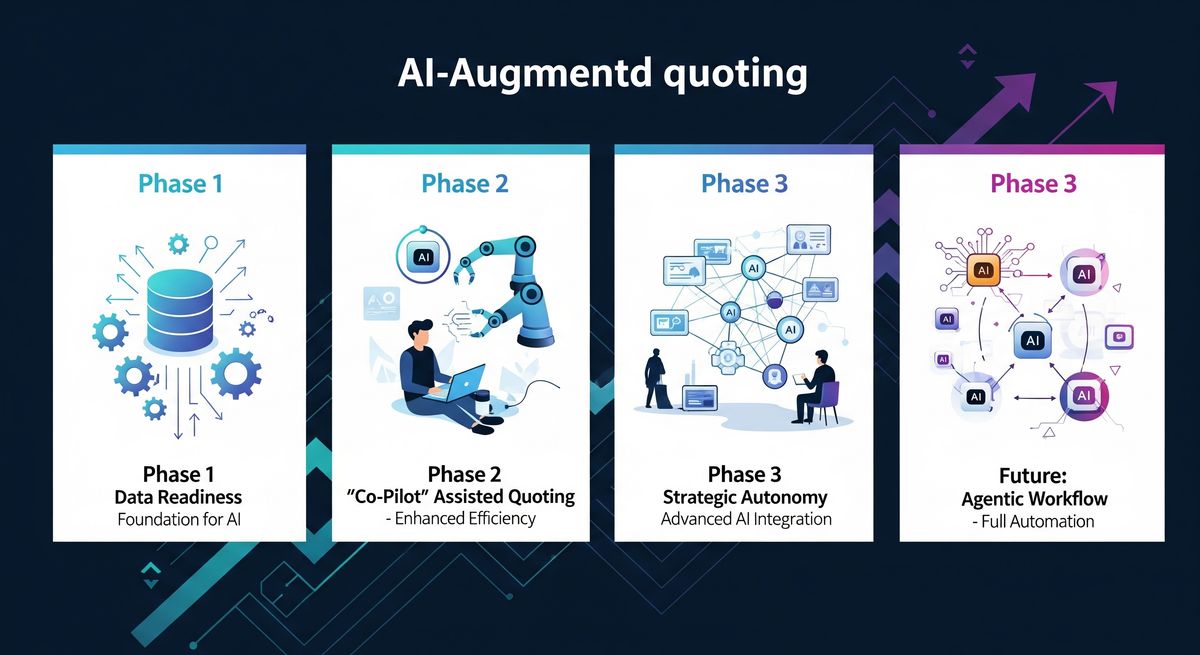
Transitioning to AI-augmented quoting is a transformational journey requiring a phased roadmap.
Phase 1: Foundation and Data Readiness
AI demands clean data. Shops must audit historical ERP/MES data and standardize naming conventions. "Tribal knowledge" must be digitized: interview the "Bobs" and translate their heuristics into rule sets (e.g., "Inconel 718 increases cycle time by 40%"). This logic forms the AI's initial training layer. Assessing your data readiness is the first critical step.
Phase 2: The "Co-Pilot" Model
Deploy AI as an assistant. The system generates draft quotes, which human estimators review. This "human-in-the-loop" approach builds trust and provides a feedback loop for algorithm training. Shops should start by automating quotes for simple, standard parts to free up human capacity for high-value projects. Platforms like Paperless Parts facilitate this transition by providing the infrastructure for digital quoting.
Phase 3: Strategic Autonomy
Implement an AI "gatekeeper" to automatically triage RFQs. The system instantly rejects work outside capabilities, auto-quotes low-risk parts, and routes complex jobs to experts. Full integration with ERP and MES allows quotes to reserve capacity and generate BOMs automatically, creating a seamless digital thread.
5.2 Future Outlook: The Agentic Workflow
We are moving toward an Agentic future where AI agents negotiate directly. A customer's procurement AI might send an RFQ to a manufacturer's sales AI, negotiating price and lead time within pre-defined parameters in milliseconds. For the manufacturing professional, this is liberation. It removes administrative drudgery, allowing human intellect to focus on engineering art, business strategy, and relationships.
This transformation is enabled by tools like our FastQuote AI accelerator, which helps manufacturers respond to quote inquiries faster. By embracing this transformation, manufacturers escape the "lowest bidder" trap. They evolve into strategic partners, armed with cognitive tools to deliver speed, precision, and value. The era of the spreadsheet is over; the era of the cognitive shop floor has begun.
Table 1: The AI Implementation Roadmap
As manufacturers embark on this transformative journey, selecting the right implementation partner is critical to bridging the gap between legacy systems and future-state autonomy.
Alpha Technical Solutions specializes in helping industrial organizations navigate this complexity, offering bespoke AI transformation strategies that align technical capability with business value. Whether you are establishing your data foundation or deploying advanced predictive models, their people-first approach ensures that your transition to the cognitive shop floor drives sustainable growth and measurable efficiency.