

The 60-Day Transformation: Engineering Self-Funding AI Ecosystems in Modern Manufacturing

The industrial landscape of the late 2020s is defined by a paradox: an abundance of technology coupled with stagnant operational impact. While artificial intelligence and edge computing are commercially mature, nearly 70% of digital transformation initiatives fail to meet their primary objectives. This has created a systemic phenomenon known as Pilot Purgatory, where innovative projects remain trapped in lab settings, often addressing the AI Leadership Paradox that prevents true enterprise integration.
Escaping this cycle requires a departure from traditional five-year roadmaps in favor of a "Speed-to-Value" imperative. By focusing on 60-day "micro-wins," organizations can demonstrate immediate ROI, build cultural trust, and establish a self-funding model for long-term innovation. This report provides a technical blueprint for three high-impact implementation projects: energy optimization, computer vision quality control, and predictive maintenance for critical bottlenecks.
Part 1: The "Speed-to-Value" Imperative
The Structural Anatomy of Pilot Purgatory
The "AI Value Gap" is rarely a failure of technological selection; it is a symptom of a deeper misalignment between innovation strategy and industrial reality. Analysis of successful deployments suggests that value generation follows the 10-20-70 principle: 10% of the value comes from the selection of algorithms, 20% from the underlying data and technology infrastructure, and a critical 70% from the people, processes, and cultural transformations that occur around the tool. Laggards often attempt to automate old, broken processes, whereas leaders fundamentally redesign workflows to leverage machine intelligence.
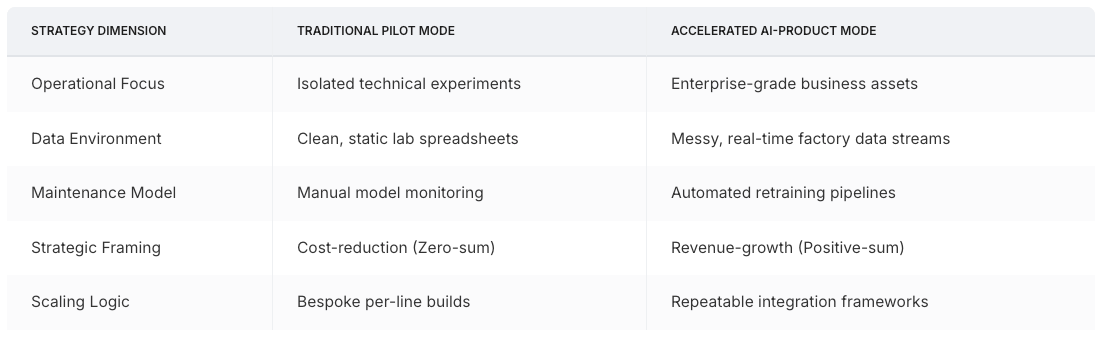
Furthermore, poor data quality remains the single largest technical hurdle. Models trained on clean, static lab data often fail when exposed to the noisy, inconsistent streams of a live factory floor, and building a data foundation for AI must become a primary strategic priority. Overcoming this requires a transition from an "AI Project" mindset to an "AI Product" mindset, utilizing Machine Learning Operations (MLOps) frameworks to ensure model stability and governance.
The Self-Funding Transformation Model
Forward-thinking organizations treat AI as an operational optimization that pays for its own expansion. Savings generated by early-stage "quick wins"—such as a 12% reduction in energy waste or a 30% reduction in scrap costs—are immediately reinvested into Phase 2 initiatives, accelerating the journey From Pilot to Production.
Case studies from industry leaders validate this approach. Emirates Global Aluminium (EGA) established a "digital factory" that produced customized use cases in quarterly waves. To date, this factory has delivered over 80 customized use cases with a combined impact exceeding $123 million, making the entire transformation self-funding from the start. Similarly, IBM internal initiatives have driven billions in productivity gains, resulting in significant free cash flow that enables continuous investment in growth, talent, and innovation.
Cultural Buy-in through Visibility and Empowerment
Workforce resistance is a primary predictor of failed AI programs, often driven by a fear of job displacement or a lack of clarity regarding the tool's utility. To overcome this, AI initiatives must prioritize "Human-First" strategies that empower frontline workers rather than replacing them. Shop-floor veterans are statistically more optimistic about AI than in other sectors, with 79% of frontline workers expressing a desire for AI to handle repetitive tasks.
Buy-in is achieved when AI solves "invisible" headaches—tasks that are burdensome but historically difficult to measure. This shift gives rise to the AI process engineer, a new role where shop-floor experts use low-code tools to build applications that optimize their own production lines, cutting problem-resolution time in half.
Part 2: Project #1 – The Energy Efficiency Quick-Win

Identifying the "Phantom Load" and Non-Value-Add Consumption
Energy consumption in industrial facilities is often viewed as a fixed cost, yet significant portions of this energy do not contribute to value-added activities. "Phantom loads," or standby power consumed by machinery during idle periods and shift changes, often represent 5% to 10% of total electricity consumption. Traditional metering systems, providing only aggregated monthly data, are incapable of identifying these granular waste patterns.
Advanced smart meters enable real-time tracking of critical parameters including real power P, reactive power Q, and power factor \cos \phi = \frac{P}{S}. To automate the detection of these inefficiencies, AI systems utilize the Isolation Forest algorithm for unsupervised anomaly detection. This system identifies usage deviations in 30-second intervals, flagging machinery left running or inefficiently configured.
Dynamic Demand Response and ML-Driven Load Shifting
Industrial utilities frequently impose "Peak Demand" penalties based on the single highest consumption window in a billing cycle. AI-driven Energy Management Systems mitigate these costs through demand response programs. Machine learning models correlate production schedules with utility peak-pricing windows and weather-driven grid stress to forecast when these peaks are likely to occur. By using reinforcement learning to optimize demand policies, the system automatically "shapes" the load—shifting non-critical, energy-intensive tasks to periods of lower grid demand without disrupting throughput.
Part 3: Project #2 – Computer Vision for High-Cost Defect Detection

Augmenting the Human Eye with Edge AI
In high-speed manufacturing, the human eye is subject to fatigue and cognitive bias, leading to an "escape rate" of defects that can reach customers.Traditional automated inspection systems often struggle with variances in lighting or part positioning, which is why the AI transformation of quality control relies on convolutional neural networks to identify patterns with millisecond precision. Deploying "Edge AI" is critical here; by running inference locally, the system avoids the latency associated with cloud processing, enabling real-time rejection of faulty parts.
Reducing "Scrap and Rework" through Real-Time Feedback
The economic impact of a defect increases as it moves through the production chain.AI vision systems act as 'Quality Gates' that provide real-time feedback to upstream machines, effectively creating a digital poka-yoke for modern production lines. This closed-loop architecture allows machines to self-correct parameters—such as adjusting pressure if a sealant bead is thinning—preventing the production of scrap before it happens. In high-value industries like composite wind blade manufacturing, such systems have reported annual savings exceeding $200,000 in scrap and rework costs.
The 60-Day Payoff: Target Quality Metrics
A 60-day computer vision pilot focusing on the most error-prone inspection point targets a 30% reduction in scrap costs and a measurable increase in first-pass yield (FPY). Furthermore, synthetic data generation can reduce the ramp-up time for these systems from months to just a few weeks, making the 60-day timeline highly achievable for electronics and automotive assembly.
Part 4: Project #3 – Predictive Maintenance for Critical Bottlenecks

The "One-Machine" Focus for Maximum ROI
The common "connect-everything" mistake often leads to data overload and stalled implementation. For a 60-day win, the focus must be narrowed to the single most critical bottleneck, mastering Proactive Machine Health for the asset whose failure halts the entire facility. By instrumenting this specific asset with triaxial vibration and thermal sensors, maintenance teams can move from reactive schedules to a condition-based approach.
Predictive Maintenance (PdM) identifies early failure signatures:
- Vibration Analysis: 3-axis accelerometers detect bearing wear and misalignment.
- Thermal Monitoring: IR sensors identify friction-induced heat before failure.
- Current Waveforms: Hall effect sensors detect electrical disturbances and motor strain.
Identifying the "Signature of Failure" 72 Hours Out
The objective of AI in PdM is to identify anomalies invisible to human senses or simple threshold alarms. In many critical assets, such as tailings thickeners used in mining, a 72-hour lead time is possible by monitoring mass imbalances. Identifying a drift 72 hours early triggers a prescriptive action—such as adjusting pump speed—to prevent a "bogging" event that would otherwise require days of manual recovery labor and cost hundreds of thousands of dollars in repairs. Similarly, specialized Acoustic AI sensors can now detect micro-leaks in boiler tubes 48 to 72 hours before traditional monitoring.
Part 5: Conclusion – Scaling the Momentum
Synthesizing the Gains: The Aggregate ROI
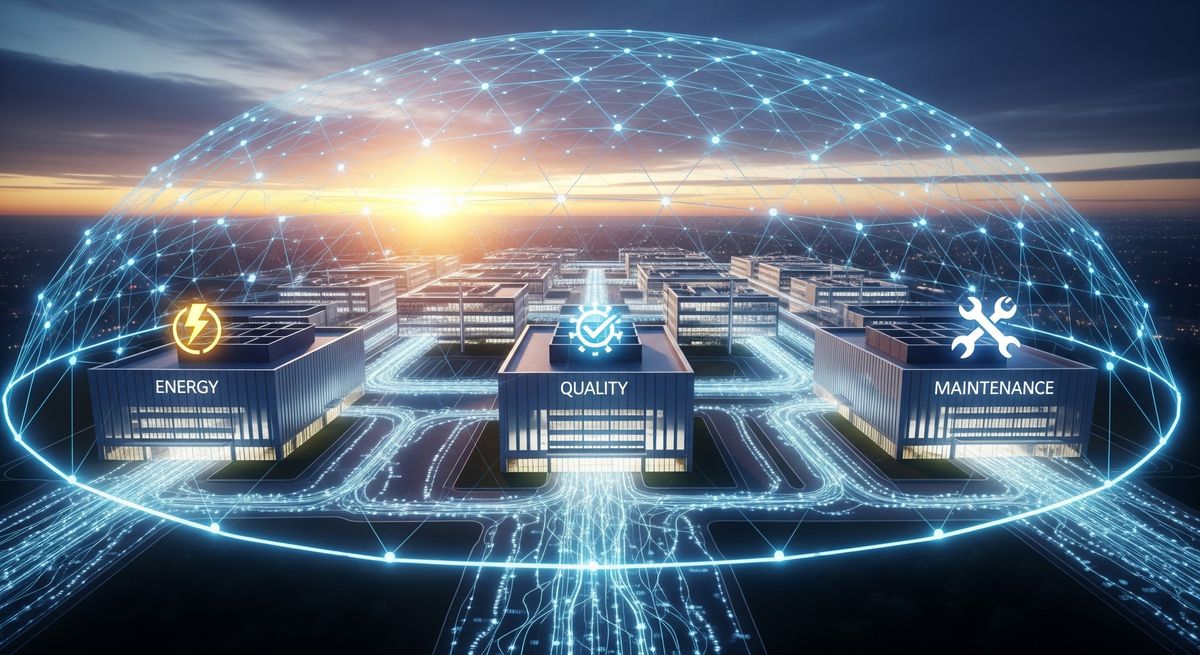
The cumulative impact of these three projects creates a powerful narrative. By week eight, the organization has moved beyond theoretical discussion into "Real-World Proof Points." The aggregate savings from energy, quality, and maintenance provide the internal capital necessary to fund larger Phase 2 initiatives, with a continued focus on Scaling Agentic AI Operations for sustainable impact.
The New Operational Standard
As AI maturity increases, the focus shifts from automation to orchestration—coordinating people, machines, and real-time data into a cohesive, adaptive system. This new standard involves using AI to automate Documented Procedures (SOPs) and workflow diagrams, keeping them current with actual shop-floor reality. Trust in AI is no longer based on faith but on the "Flywheel Effect," where every successful deployment generates better data, which in turn trains more accurate models.
Call to Action: The Clock Starts Now
The most significant risk in the current industrial landscape is not the failure of an AI pilot, but the failure to start. Lengthy roadmaps often create their own problems, leading to technology obsolescence before deployment. The antidote is the 60-day sprint. Leaders are encouraged to pick one bottleneck, start the clock, and let the results lead the strategy. The technology has caught up; the only requirement is the organizational will to begin.
—------
The shift toward an AI-augmented industrial floor is no longer a matter of future speculation but a present-day operational requirement for maintaining competitive margins. By leveraging a structured, 60-day roadmap, organizations can transform isolated pilot experiments into robust, self-funding ecosystems that drive immediate value and long-term resilience. Success in this new era requires the right technical foundation and a strategic partner dedicated to navigating the complexities of industrial AI deployment. To explore how your facility can bridge the gap from data to actionable intelligence and ensure your transformation delivers on its promise, connect with the specialists at ATS.