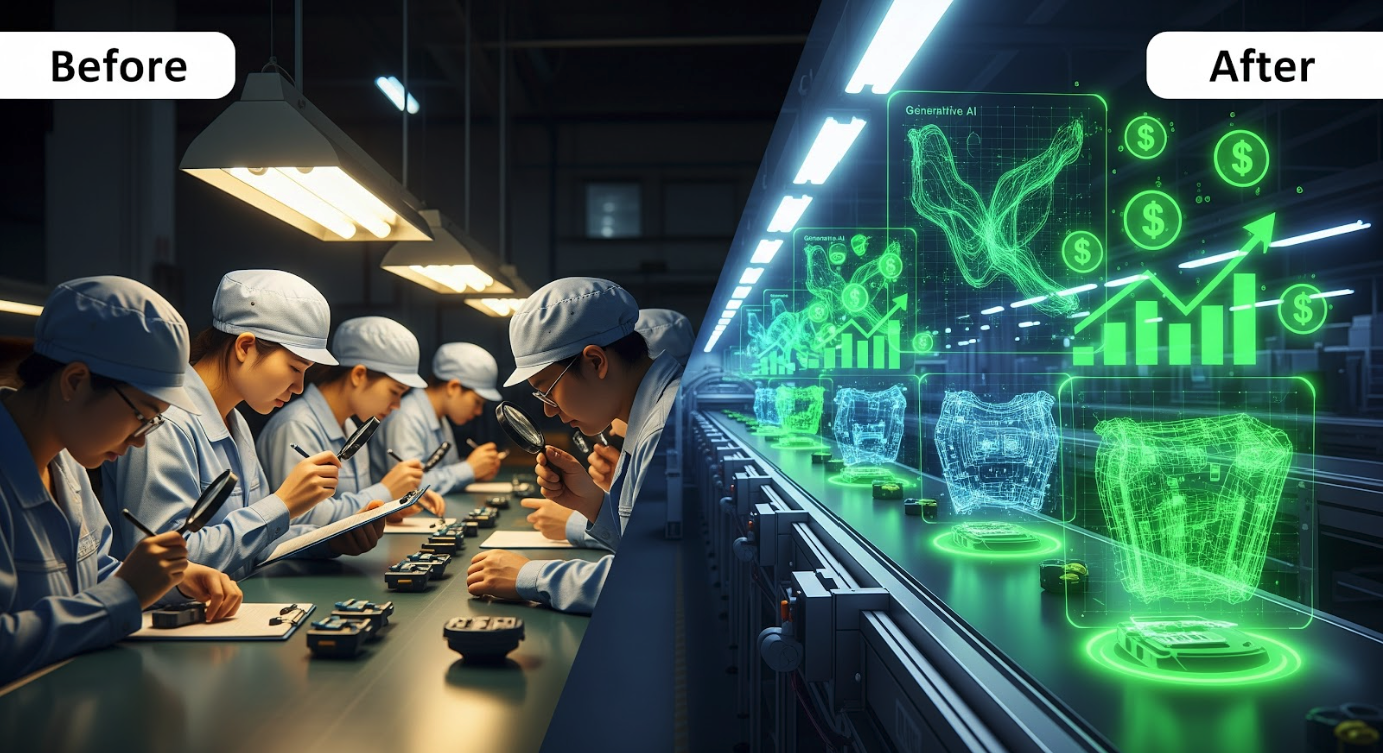


The global industrial landscape in 2026 stands at a critical juncture, characterized by a profound disconnect between the proliferation of artificial intelligence and its measurable impact on corporate performance. While enterprise adoption of AI has reached approximately 78% globally, the AI Leadership Paradox reveals that the anticipated windfall of productivity remains largely elusive for the majority of practitioners. This phenomenon, widely recognized as the "AI Productivity Paradox," mirrors the observations of economist Robert Solow during the early computer age: the technology is visible everywhere except in the productivity statistics. To navigate this landscape, professionals must move beyond the superficial narrative of "plug-and-play" automation and embrace the rigorous reality of the AI J-Curve—a statistical trajectory where adoption initially depresses performance before systemic gains emerge.
1. Introduction: The Mirage of the "Plug-and-Play" Factory
The modern factory and corporate office are often marketed as environments primed for immediate AI integration. This marketing narrative suggests that AI is a software layer that can be "switched on" to instantly optimize throughput, reduce waste, and enhance decision-making. However, empirical data from 2025 and 2026 suggests that this "plug-and-play" vision is a mirage that obscures the fundamental friction of technological transition.
The Paradox Defined: The Statistical Reality
The framework for understanding current economic stagnation is the realization that the introduction of AI into manufacturing and business functions leads to a measurable, albeit temporary, decline in performance. The average firm experiences a productivity drop of 1.33 percentage points during the initial years of deployment. This decline is not merely a consequence of "growing pains" but a reflection of the reallocation of resources. When a firm invests in a general-purpose technology like AI, it must divert capital and human labor from production to the creation of unmeasured foundations: process redesign, data cleaning, and organizational learning.
The 60% Statistic: Contextualizing the Valley of Despair
The "valley of despair" represents the bottom of the J-Curve, a period characterized by negative return on investment (ROI) and the stagnation of pilots. Recent surveys indicate that 60% of manufacturers find themselves trapped in pilot purgatory, unable to scale their AI initiatives beyond isolated experiments. While over 90% of organizations are actively piloting AI, only 5% report having achieved their program goals. This high failure rate is often attributed to initiatives remaining disconnected from core business strategy, forcing firms to upgrade legacy infrastructure while simultaneously competing with AI-native firms.
The Thesis: Transformation as Organizational Overhaul
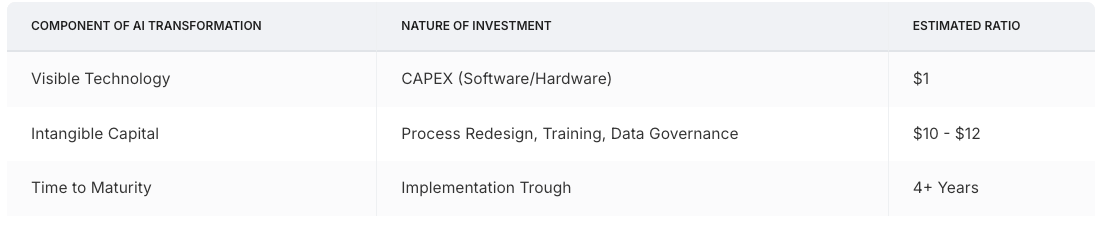
The central thesis of successful transformation in 2026 is that AI is not a tool but an operating system change. True Industrial AI success belongs to the "implementation leaders" who budget not just for the visible costs of hardware and algorithms, but for the "invisible" costs of structural redesign. Evidence suggests that firms persisting through the implementation trough for at least four years achieve outsized returns, with over 60% of such mature firms reporting productivity improvements exceeding 25%.
2. The Hidden Drain: Why the "J-Curve" Bottoms Out

The downward slope of the J-Curve is driven by three primary "drains" on organizational energy and capital: the technical friction of legacy systems, the cognitive load on operators, and the emergence of synthetic busywork.
The Misalignment of Legacy Systems
One of the most significant barriers to AI success is the attempt to marry 21st-century intelligence with 20th-century infrastructure. Over 60% of companies report that they must address fundamental issues—such as duplicated functionality and fragmented IT/OT stacks—before AI can generate value. In the manufacturing sector, AI is frequently deployed for predictive maintenance, quality control, or demand forecasting, applications that are highly sensitive to dirty data—information that is inconsistent, siloed, or lacks historical context. The effort required to clean and normalize this data creates a massive upfront cost that slows the time to first measurable value.
The "Double Burden" of Implementation
The "double burden" refers to the dual pressure placed on the workforce. To train an AI model effectively, a firm must pull its most experienced and productive operators away from their primary duties. These employees are needed to provide the "ground truth" data that AI requires to learn. While these operators are busy overseeing integration, the firm’s primary production capacity often suffers. Furthermore, while nearly all C-suite leaders expect AI to boost productivity, 77% of employees report that these tools have actually added to their workload, driven by the need to manage the culture shift and attend training sessions.
Organizational Inertia and "Workslop"
A more insidious drain is the rise of workslop—a term used to describe AI-generated content that looks polished but lacks substance or context. Workslop masquerades as productivity but creates more work for the organization, costing an estimated $186 per employee per month in wasted time. It occurs when AI is poorly integrated, leading to a "shadow AI economy" where employees use unapproved tools to perform tasks without organizational guardrails. The result is a "paradox of apparent efficiency": generating a million words in seconds but spending hours correcting them.
3. The Structural Shift: Moving Beyond the Pilot Purgatory

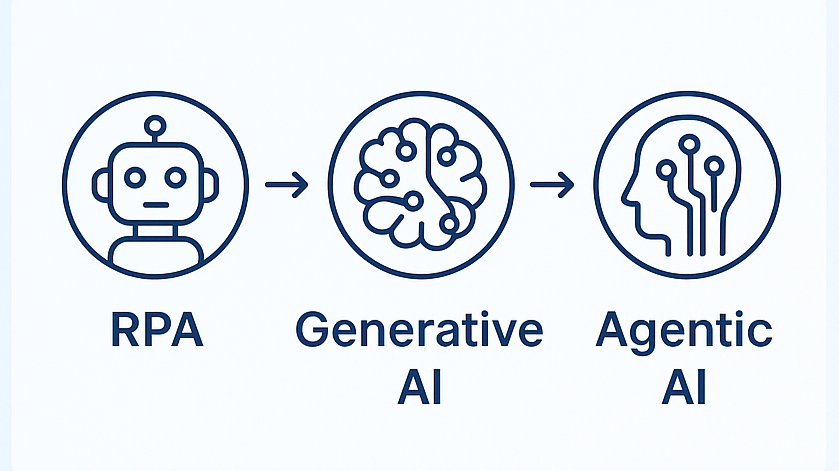
To escape the valley of despair, organizations must shift from viewing AI as a tool for task automation to viewing it as a system for workflow optimization. This marks the move toward Agentic AI—autonomous systems designed to manage multi-step workflows rather than simple point solutions.
From Task Automation to System Optimization
The firms that succeed in crossing the J-Curve focus on systems that can perceive their environment, make independent decisions based on goals, and act with minimal human intervention. A notable case study in ceramic manufacturing facility implemented an autonomous multi-agent system to monitor hydraulic presses and kilns. Unlike traditional monitoring, these agents utilized federated learning to share knowledge across production sites while achieving 94% predictive accuracy. The operational result was a 43% decrease in unplanned downtime and a 1.6-year payback period.
The Intangible Capital Requirement: The $1:$10 Ratio
Economic research indicates that AI enables and requires significant complementary investments that are frequently unmeasured. To account for the "lost" output during implementation, the quantity of correlated investments in intangible assets—such as business process redesign and internal R&D—must be several times the observable technology investment. In practice, for every dollar spent on an AI license, a firm should expect to spend ten dollars on ensuring the data foundation is ready and the culture is adapted to support the new system.
Bridging the Skills Gap
The transition through the J-Curve fundamentally alters the AI talent landscape and the role of the workforce. We are moving from a paradigm of "labor expansion" to "labor optimization," where employees move from manual tasks to "AI-orchestration" roles. This shift requires a massive reskilling effort. While some manufacturers expect AI to reduce headcount, the majority foresee an increase in specialized roles. To succeed, organizations must move to a concept where humans have genuine discretion over choices and enough context to understand machine behavior, rather than simply acting as moral buffers for machine errors.
4. The 2026 Reckoning: Differentiating Leaders from Laggards
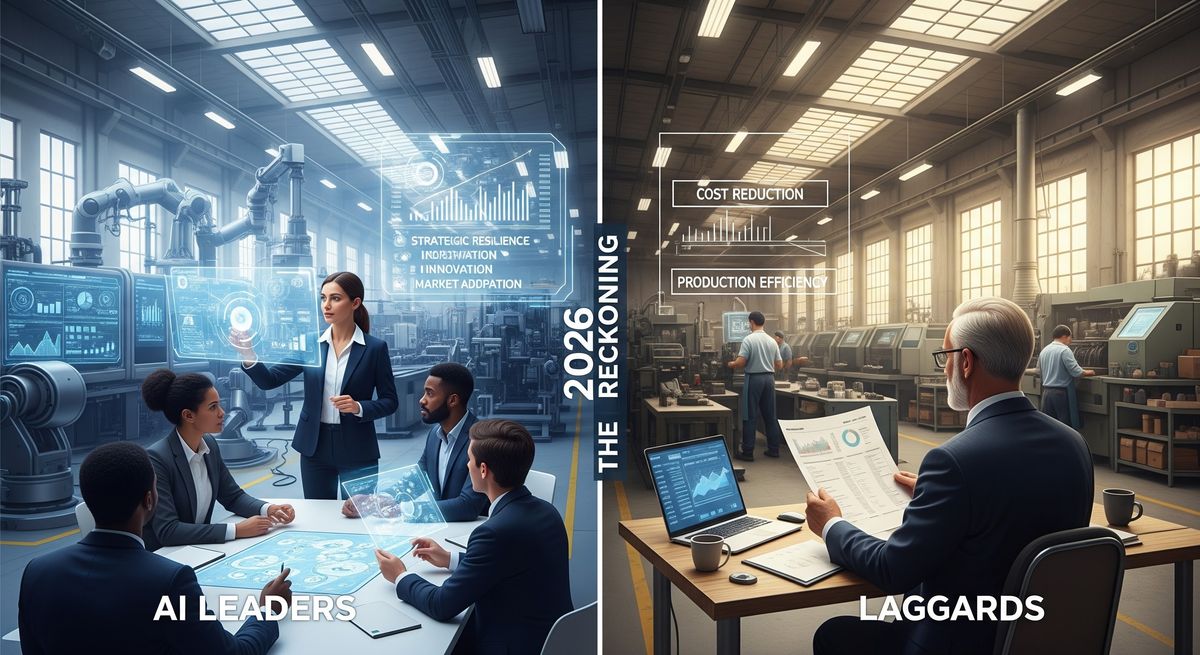
As we enter 2026, the industrial world is being bifurcated into AI "Leaders" and "Laggards." This reckoning is defined by digital maturity, a shift in the CFO’s role, and a transition from efficiency-based metrics to strategic resilience.
The Strategic CFO’s Role
The financial assessment of AI is maturing. In 2026, the CFO's role is shifting from funding experimental R&D to overseeing structural capital expenditure. Total Business Value has become the top-line KPI, moving success metrics beyond simple cost-cutting to include improved capacity utilization and reduced working capital. CFOs are increasingly viewing data as a structural asset and are allocating over 20% of digital budgets specifically to AI-driven outcomes.
ROI Beyond Efficiency: Resilience as Strategy
The most significant strategic shift is the narrative transition from efficiency to strategic resilience. Leaders are using AI to build supply chains that can absorb shocks and navigate volatility. For instance, nearly 60% of aerospace companies are pursuing strategic localization—balancing global trade efficiency with the security of local production. AI allows these firms to model capacity buffers and run stress tests against disruption scenarios, essentially embracing the AI-Native Industrial Revolution through technology sovereignty.
In energy management, agentic systems are providing energy consumption monitoring that autonomously adjusts manufacturing equipment, identifying savings of 10-20% and reducing overall consumption by up to 30%. Similarly, as supply chain attacks project costs of $60 billion, cyber resilience has become a priority. CFOs are applying risk management formulas to justify security budgets:


Where:
- ALE = Annualized Loss Expectancy.
- SLE = Single Loss Expectancy.
- ARO = Annual Rate of Occurrence.
5. Conclusion: Surviving the Valley to Reach the Peak

The AI Productivity Paradox is a temporary state of transition, not a permanent failure of technology. The initial decline in productivity is a necessary signal of the "unlearning" process—the period during which an organization must shed outdated habits and build the intangible capital required for a new industrial era.
The journey through the J-Curve is defined by the recognition that transformation is systemic. The "valley of despair" is paved with the costs of legacy misalignment and the noise of workslop. However, those who persevere—investing heavily in the organization itself—eventually reach the pivot point where productivity gains become exponential.
While the J-Curve is painful, the "L-Curve" of stagnation is fatal. Firms that refuse to adopt AI or that abandon their initiatives during the implementation trough risk market obsolescence. Non-adopters may avoid the initial productivity dip, but they will find themselves on a long-term trajectory of declining competitiveness. Leaders must embrace the "messy middle" of transformation by budgeting for the invisible, implementing clear digital poka-yoke governance to prevent synthetic busywork, and redefining value through the lens of strategic resilience.
Ultimately, the successful adoption of industrial AI requires bridging the gap between technical potential and organizational readiness. Executives must lead with a vision that prioritizes the structural integrity of their data and the agility of their workforce. For those ready to accelerate this transformation and navigate the complexities of the J-Curve with confidence, expert support is available through ATS.