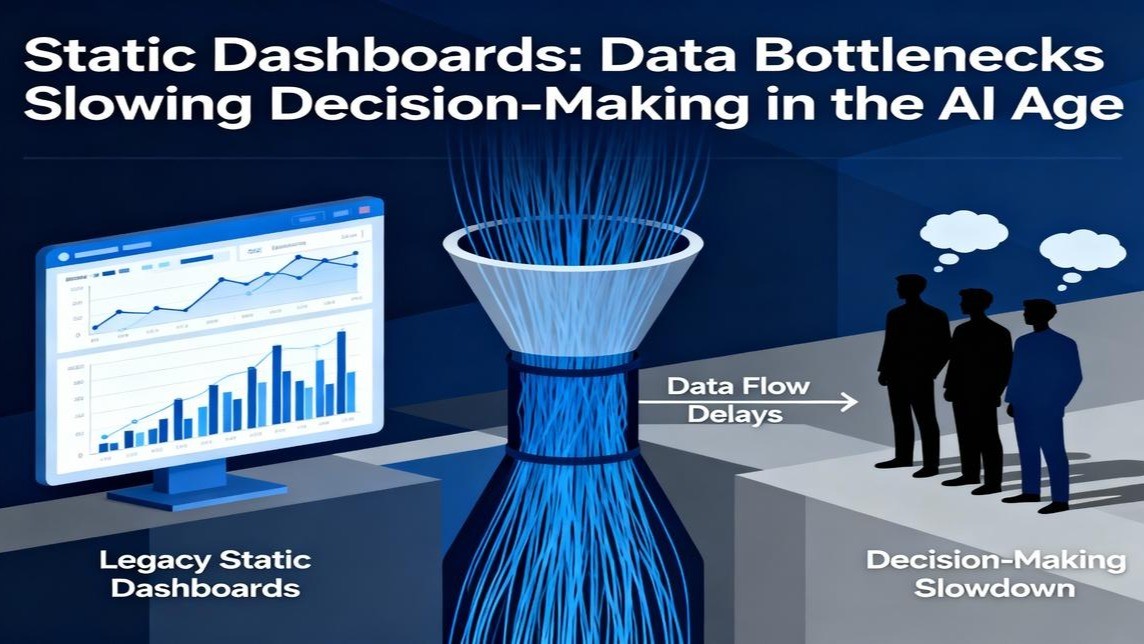

The Strategic Architecture of AI Transformation: Tool-Wear Twins, Predictive Sensing, and the Economic Pricing of Uncertainty

Industrial enterprises are entering an era where operational efficiency is no longer defined by the absence of failure, but by the precision with which they manage uncertainty. The traditional paradigm of maintenance, once a reactive or at best a scheduled periodic function, has been fundamentally disrupted by the confluence of high-fidelity digital twins, real-time sensing, and advanced artificial intelligence. The transition from "smart maintenance"—a tactic focused on localized optimization—to strategic uncertainty management represents a profound shift in how manufacturing organizations perceive and monetize their physical assets.
In this context, the tool-wear digital twin emerges as a critical lever for profitability, particularly as the economic stakes of unplanned downtime reach unprecedented levels. For the world’s 500 largest companies, these disruptions now sap approximately $1.4 trillion annually, equivalent to 11% of their total revenues. This shift is part of an AI-native industrial revolution where generative intelligence is redefining the very logic of how goods are produced and maintained. Within high-value sectors such as automotive manufacturing, a single hour of downtime can cost up to $2.3 million—a figure that has more than doubled since 2019. This report argues that competitive advantage will not be found in the mere possession of digital twins, but in the sophisticated ability to know when to simulate, when to sense, and how to price the inherent uncertainty of physical processes.
1. Introduction: From Smart Maintenance to Strategic Uncertainty Management
The evolution of industrial operations is characterized by an increasing move toward behavioral foresight, where digital systems are used to understand how networks and equipment behave under varying degrees of stress. Historically, maintenance was a peripheral concern, managed through simple heuristics. The advent of "smart maintenance" introduced sensors and basic predictive algorithms, but these were often siloed tactics. Strategic uncertainty management, by contrast, integrates these capabilities into the core executive function, aligning analytics with financial risk profiles.
The architecture of this transformation rests on four foundational concepts: tool wear, digital twins, the simulation-sensing duality, and uncertainty pricing. By mastering proactive machine health, organizations can transition from reactive responses to intelligent, AI-powered predictive maintenance. A digital twin is a virtual representation of these physical entities, processing live data to mirror behavior. The strategic tension lies in the balance between simulation—using mathematical models to explore "what-if" scenarios—and sensing—using real-time data to correct these models.
1.2 The Economic Imperative of the Digital-Real Link
The necessity of this shift is driven by the escalating costs of operational failure. In heavy industry, the hourly cost of downtime has risen by 319% over the last five years, driven by rising energy prices and increasing supply chain complexity.
2. When to Simulate: Designing for “What If”
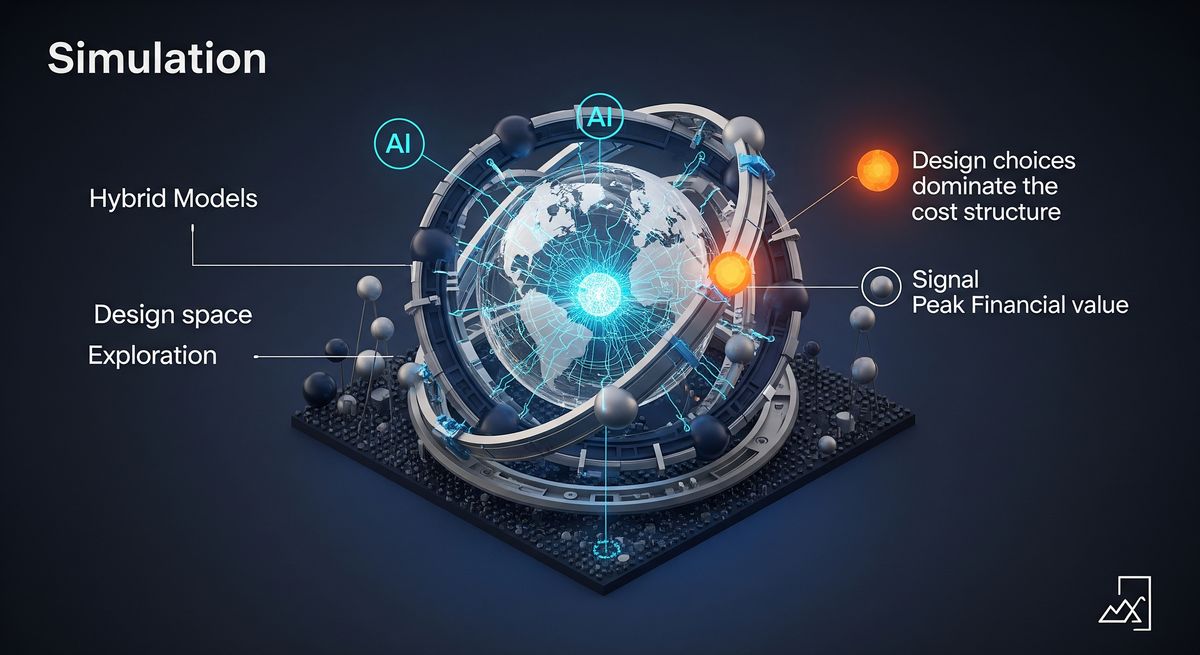
Simulation represents the proactive arm of the digital twin strategy. It allows teams to explore the design space and maintenance policies before physical tools are ever touched, effectively front-loading the decision-making process. For many high-capital industries, simulation is not just an optimization tool; it is a necessity for financial survival.
2.1 Simulation for Exploration and Virtual Commissioning
The primary advantage of simulation-heavy twins is their ability to perform analysis on alternative scenarios. In sectors like aerospace or semiconductor manufacturing, the "trial and error" method is prohibitively expensive. Virtual commissioning enables the high-fidelity validation of production line design, reducing resource consumption during physical equipment commissioning. However, moving from pilot to production requires a disciplined approach to scaling these models to drive true manufacturing excellence across multiple sites.
2.2 Physics-Informed and Hybrid Models
A significant limitation of pure data-driven machine learning (ML) is its inability to extrapolate accurately beyond historical data. To address this, sophisticated practitioners are turning to physics-informed neural networks and hybrid models. These models combine the robustness of classical wear equations, such as the Taylor tool life equation, with the nonlinear learning ability of modern AI. The physical model provides a stable baseline grounded in the laws of thermodynamics, while the ML component bridges the gaps in complexity that the physical models cannot capture.
2.3 The Economic Lens on Simulation Investments
Simulation maturity should be strictly tied to the financial value of the decisions made upstream. For instance, a European electronics firm that simulated tariff scenarios using a digital twin improved its landed cost performance by 11.6% and restored on-time delivery to 97%. The decision was made entirely in the simulation space, preventing a reactive crisis in the physical world.
3. When to Sense: Real-Time Reality Checks
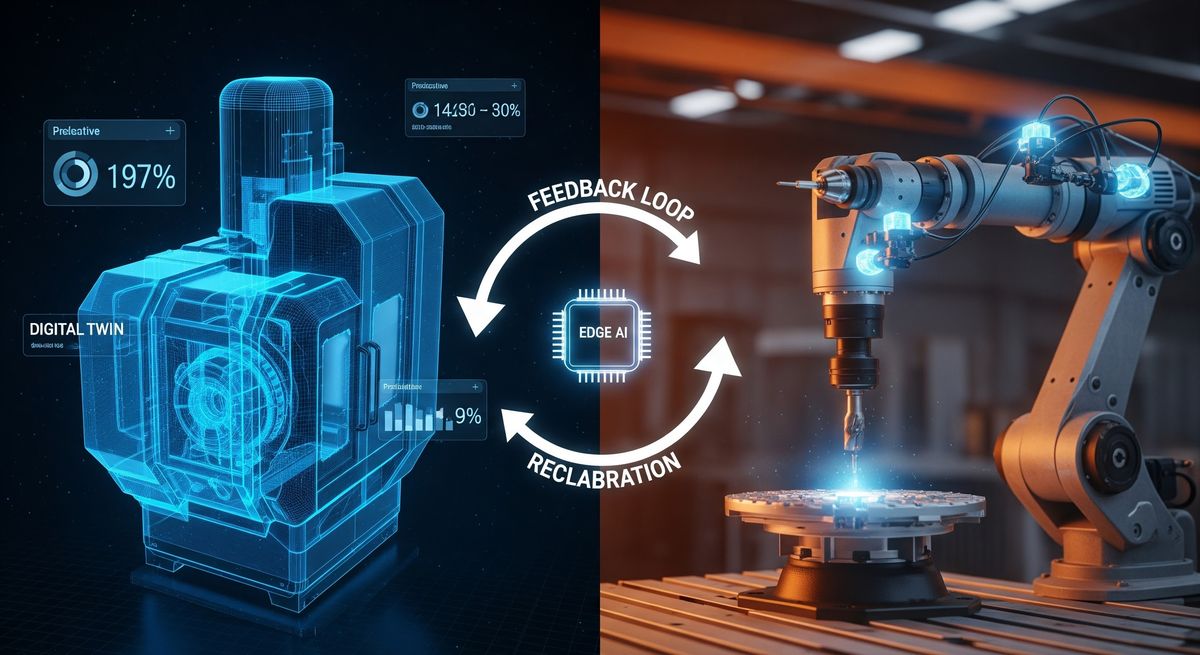
While simulation allows for foresight, sensing provides the essential real-time reality check. Dense sensing is critical once tools are in production, especially when high-stakes variability is high. Sensing systems, particularly those leveraging Edge AI, eliminate the latency of cloud-based processing, enabling millisecond responsiveness. In the semiconductor industry, where each hour of downtime can cost over $1 million, real-time feedback is a strategic imperative.
3.1 From “More Data” to “Better Signals”
A common misconception in AI transformation is that more sensors always lead to lower risk. In practice, the focus must shift from data quantity to signal quality and relevance. For tool wear, this means identifying the specific features—such as vibration harmonics or acoustic emission spikes—that are truly indicative of degradation. Research indicates that improving input quality through informed feature extraction is often more effective than increasing model complexity. An unexpected increase in machine vibration may indicate misalignment or bearing issues long before a traditional threshold-based monitor detects an alarm.
3.2 Closing the Loop: Sensing as a Feedback Channel
The ultimate role of sensing is to act as a feedback channel that continually recalibrates the digital twin. This prevents the twin from becoming a static representation. Through drift detection, sensors identify when the tool’s behavior no longer aligns with the model’s predictions. This mutual calibration—where the model predicts reality and reality corrects the model—is the hallmark of an advanced predictive system.
4. How to Price Uncertainty: Model Error as a Line Item

The final stage of AI maturity is the ability to treat uncertainty not as an embarrassment to be hidden, but as a strategic asset to be priced. This involves making technical uncertainty explicit and translating it into financial risk.
4.1 Making Uncertainty Explicit and Measurable
In the context of tool wear, uncertainty is defined as the prediction error in remaining useful life (RUL) or the confidence interval around a failure risk. Mature organizations quantify this error using statistical frameworks. Total prediction error can be decomposed as:

By understanding these components, managers can decide whether to invest in a better model (to reduce bias), more data (to reduce variance), or a larger contingency fund (to handle noise).
4.2 Economic Frameworks for Information Value
The Expected Value of Perfect Information (EVPI) is a vital decision-theory tool for this translation. It calculates the maximum amount a decision-maker would be willing to pay for complete knowledge of an outcome, thereby placing an upper bound on the value of any additional sensing or simulation. If the EVPI is lower than the cost of a new sensing project, the project should be rejected.
4.3 Governance and Operating Model Implications
Managing uncertainty pricing is a human challenge as much as a technical one. Organizations must build a solid data foundation to ensure that analytics are grounded in high-quality, accessible data. This shift requires managing change effectively within the operations team, as traditional silos between Finance and Maintenance are dismantled. This governance model changes conversations with vendors; instead of features, negotiations shift to value-based outcomes, such as a digital twin as a service subscription.
5. Conclusion: Toward Uncertainty-Aware Enterprises
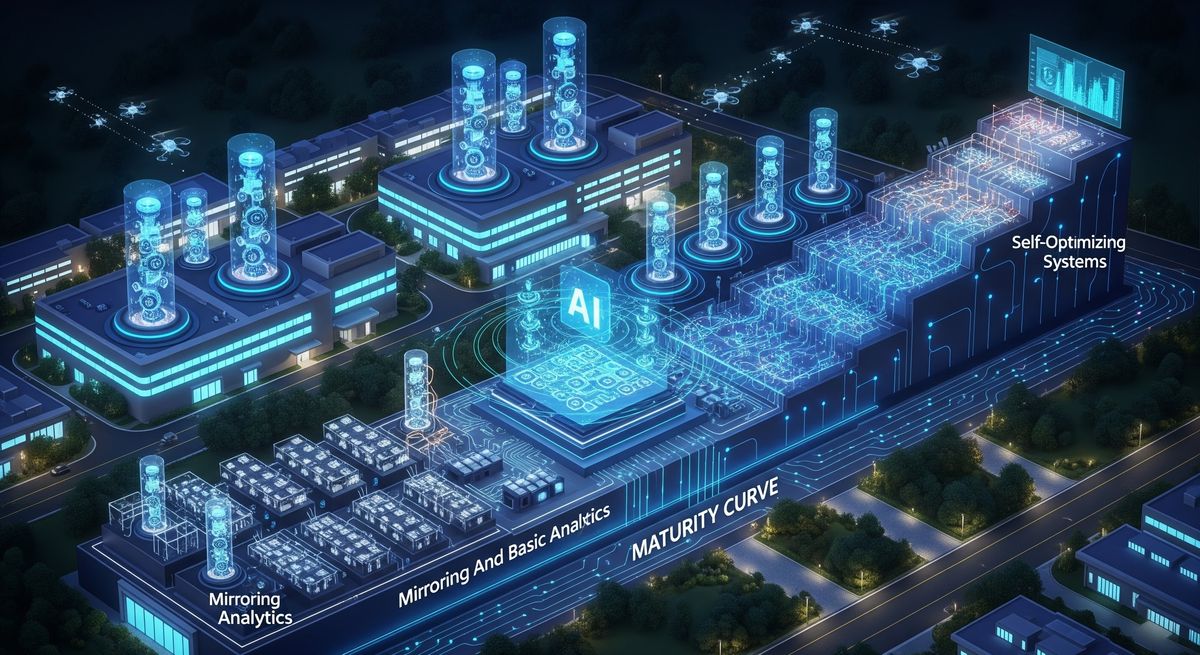
The maturity curve for AI transformation runs from “having a twin” (visualization) to “using a twin” (predictive maintenance) and finally to “pricing uncertainty” across the enterprise. Many organizations struggle here due to the AI Leadership Paradox, where investment is high but true integration remains elusive.
5.1 The Maturity Curve
At the highest levels, digital twins are self-optimizing and uncertainty-aware. They no longer just predict failure; they provide a prescriptive path that accounts for the cost of being wrong. This level of sophistication allows leaders to audit maintenance decisions and identify where they are under-pricing uncertainty—essentially carrying hidden risks that could be mitigated through explicit financial modeling.
5.2 Call to Action for Leadership
The forward-looking perspective is clear: as autonomous systems spread, excellence will be defined by those who treat uncertainty as a strategic asset. By embracing a trustworthy AI framework, organizations ensure that their AI models are not just technically accurate, but ethically and operationally sound.
As industrial leaders navigate this complex maturity curve, the focus must shift from proving the technology to proving its value through measurable, strategic execution. Achieving this level of maturity represents a long-term capability shift that integrates reliability, flexibility, and sustainability into a unified operational DNA.
—--
To thrive in this new landscape, organizations must move beyond the experimental phase and achieve true operational resilience through a synthesis of high-fidelity modeling and risk-adjusted financial strategies. By partnering with experts who understand the nuances of industrial AI, enterprises can successfully bridge the gap between technical potential and bottom-line impact. To start your journey toward uncertainty-aware operations and drive measurable value through intelligent automation, we invite you to connect with the team at ATS.